Inside Studios: How 6K Textures Actually Ship Games
By Mira Kapoor | 6 March 2026 | 15 mins read
Table of contents
Table of Contents
You’ve seen the stunning tech demos and the promises of next-gen fidelity. But back in the real world, you’re the one balancing that artistic vision against a VRAM budget that just won’t budge. This collection of case studies moves beyond the spec sheets. We’re unpacking how leading studios in gaming, VFX, and beyond are using high-resolution textures to ship stunning visuals, solve pipeline bottlenecks, and prove the ROI of quality. Think of this as less of a technical manual and more of a strategic playbook, filled with actionable insights from the front lines of visual design.
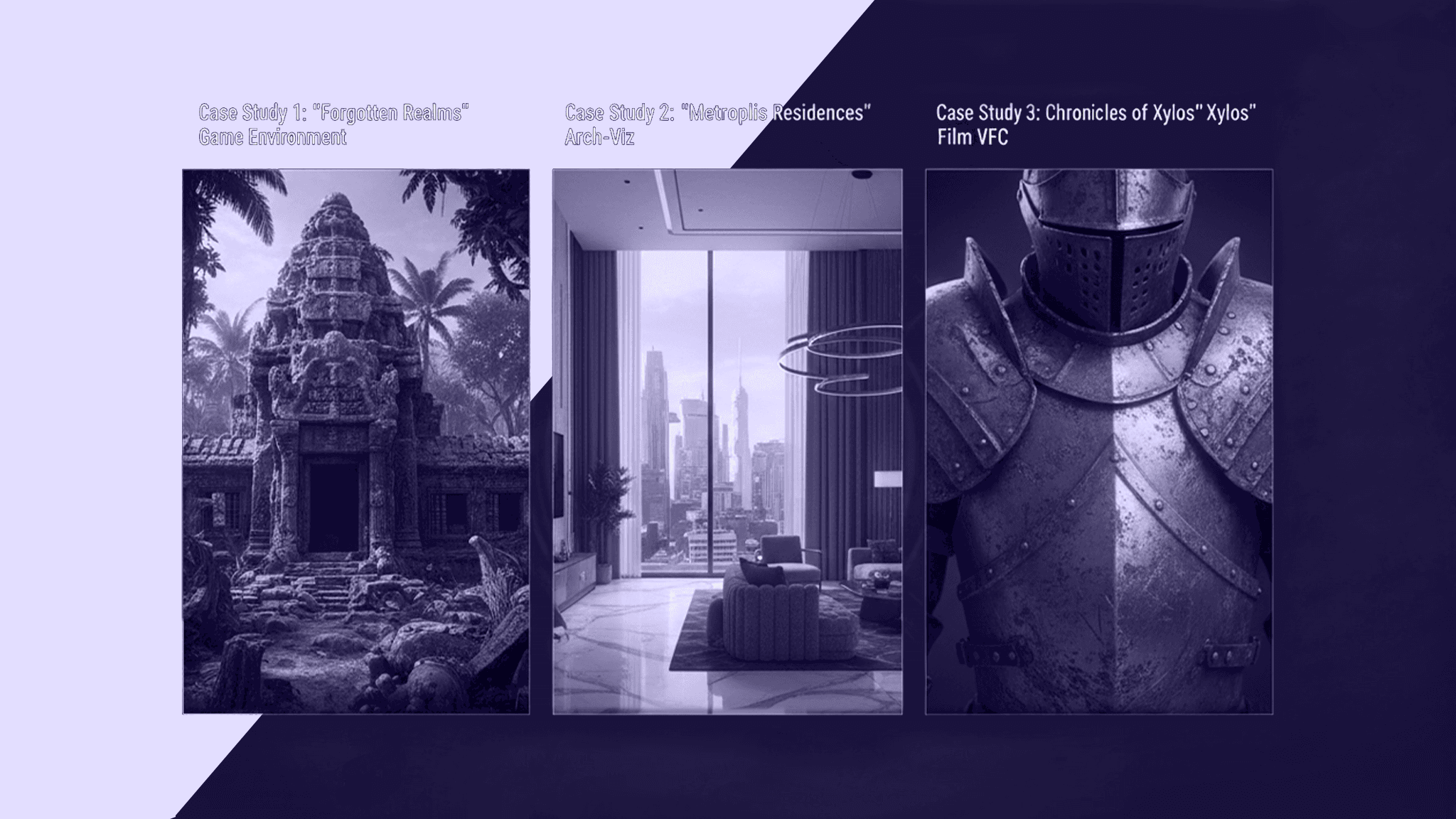
Why real-world 6K texture applications matter
You’ve seen the spec sheets and the engine demos. You know what 6K textures are. But the real question is, what do they do? The technical talk about texel density and VRAM usage is important, but it often misses the point: how does this actually help you ship a better-looking game on time?
That's where the theory ends, and the practical work begins. The difference between a good-looking asset and a truly believable world comes down to execution. These case studies aren’t just a gallery of pretty pictures. They’re taking a look under the hood at how leading studios are using high-resolution textures to solve real-world problems, problems you’re likely facing right now. We’re talking about creating immersive experiences that hook players, defining a clear PBR workflow that your artists can actually follow, and, crucially, streamlining your art pipeline to reduce your reliance on costly and time-consuming outsourcing.
Think of this as a collection of field notes from the front lines of visual design. Let's unpack how these teams are turning pixels into performance.
Part 1: Case studies in gaming & real-time rendering
For game developers, the challenge is always a balancing act: pushing for cinematic quality while dodging the bullet of performance bottlenecks. Here’s how studios are using 6K textures to win that fight.
1. Crafting photorealistic worlds in next-gen open-world games
Open-world games present a unique scale problem. An asset needs to look great from a kilometer away and hold up when the player walks right up to it. One leading studio, building a vast fantasy RPG, faced this exact challenge with its massive cliff faces and rock formations. Their solution was to use 6K textures sourced from photogrammetry, but not as a single, monolithic file.
Instead, they built a library of 6K rock and ground materials and used sophisticated shader blending based on the terrain’s slope and height. This meant a single large mesh could be textured with incredible detail without obvious tiling. To manage memory, they relied heavily on virtual texturing, streaming in only the resolution needed for the player's current view. The impact was twofold: players felt grounded in a vast, believable world, and the art team avoided the nightmare of creating unique textures for every square meter of the environment.
2. Hyper-realistic character models in AAA titles
Nothing pulls a player out of the moment faster than a character that falls into the uncanny valley. For a recent AAA narrative-driven adventure, the goal was emotional connection, which required lifelike characters. This is a prime example of high-resolution texture applications making a direct impact on storytelling.
The character art team used 6K textures specifically for facial close-ups. They split the character's head into multiple UDIM tiles, dedicating an entire 6K map just to the face to capture pore-level detail, subtle wrinkles, and micro-expressions. For the rest of the body, armor, and clothing, they used 4K textures. This tiered approach allowed them to achieve stunning fidelity during cinematic moments without blowing their VRAM budget during regular gameplay, where the engine would swap in lower-resolution MIP maps. The lesson here is strategic precision, applying the greatest detail only where it matters most.
3. Enhancing hard-surface assets in Sci-Fi shooters
In a sci-fi shooter, the player’s weapon is often the star of the show, occupying a significant portion of the screen for hours. A team working on a competitive FPS knew their weapons had to feel solid, functional, and worn. Simply using a high-resolution color map wasn't enough.
They adopted a strict PBR workflow where 6K textures were used for roughness, metallic, and normal maps. These maps told the story of each weapon. The 6K roughness map showed tiny smudges and fingerprints on the grip, while the metallic map revealed where the paint had worn away on the edges, exposing the bare metal underneath. This level of material definition made the weapons feel like real, tactile objects, not just 3D models. It improved the perceived quality of the entire game and made the gear feel more valuable and personal to the player.
4. Creating believable foliage and natural environments
Making digital nature look good is hard. Foliage, in particular, can quickly look fake and repetitive. A studio developing a survival game set in a dense forest knew their environment was a core character. They turned to 6K textures to bring it to life.
By capturing high-resolution scans of leaves, bark, and moss, they were able to create assets that felt authentic and organic. The key was in the texture mapping. For complex models like trees, they used a combination of tiled 6K bark textures for the trunk and unique maps for hero assets like large, gnarled roots. For leaves, they used 6K texture atlases containing multiple leaf variations, which allowed them to create dense canopies without obvious repetition. This approach made the forest feel less like a collection of assets and more like a living ecosystem.
5. Architectural realism in real-time simulations
In level design, architecture does more than just fill space; it tells a story and guides the player. For a post-apocalyptic title, the environment art team used 6K textures to give their ruined city a sense of history. A crumbling concrete wall wasn't just a grey slab; it featured 6K textures of rebar peeking through, water stains running down from a broken pipe, and decades of grime built up in the corners.
This level of detail served a practical purpose. The unique markings helped players navigate, turning a generic hallway into "the one with the big water stain." It also deepened the environmental storytelling, allowing the player to piece together what happened in a space long before they arrived. It's a powerful reminder that textures aren't just decoration, they're a narrative tool.
Part 2: Pushing visual boundaries in film & VFX
While real-time rendering has its own constraints, the film and VFX industry operates on a different level of fidelity. Their workflows, though data-intensive, offer a glimpse into the future of visual realism and provide powerful lessons in pushing creative boundaries.
6. The rise of digital doubles and lifelike skin shaders
For a major blockbuster, a VFX studio was tasked with creating a digital double of an A-list actor for a dangerous stunt sequence. The camera would be inches from the digital character's face. There was no room for error.
The team used a state-of-the-art facial scanning rig to capture the actor's skin, then used that data to generate a suite of 6K and even 8K texture maps. These weren't just color and bump maps; they included maps for subsurface scattering, specular roughness, and translucency. The sheer amount of data was a major challenge, requiring a robust asset management system and a powerful render farm. The result, however, was a digital human that was indistinguishable from the real actor, even in extreme close-up, proving that when absolute realism is the goal, high-resolution textures are non-negotiable.
7. Seamless matte paintings and environment extensions
Creating the sprawling, epic vistas of a fantasy film often falls to the matte painting department. For one such film, artists needed to build a massive, impossibly detailed city that would be seen from multiple angles. Instead of painting from scratch, they used a workflow built on advanced texture rendering techniques.
They started with a library of 6K photographs of real-world architecture, which were then projected onto simple 3D geometry. This allowed them to build a believable city with realistic weathering, intricate details, and perfect perspective. The high resolution of the source textures meant they could zoom in on any part of the city without the image breaking down, giving the director incredible flexibility. It’s a workflow that blends artistry with brute-force detail.
8. Texturing for digital destruction and particle effects
When a building explodes on screen, the effect is only as believable as the debris. A leading VFX house working on an action movie found that their destruction simulations felt weak. The problem wasn't the physics; it was the textures.
Their solution was to create a library of 6K textures for materials like concrete, brick, wood, and glass, specifically, textures of those materials being fractured and destroyed. When a wall crumbled, the simulation would instance geometry and apply these high-resolution destruction textures to the newly revealed inner surfaces. This added a layer of gritty realism that was missing before. The same principle was applied to particle effects, where 6K smoke and fire sprites created more believable and detailed plumes.
9. Recreating historical accuracy in period films
For a historical drama set in Victorian England, authenticity was everything. The costume design team worked hand-in-hand with the VFX artists to recreate fabrics that no longer exist. They started by studying historical samples under a microscope.
From there, they digitally recreated the intricate weaves of silk, wool, and lace using 6K texture maps. These weren't just flat images; they included normal maps to show the thread patterns and specular maps to capture the unique sheen of each material. When applied to the digital costumes, these textures suspended the audience's disbelief, making the world feel tangible and historically accurate.
10. Product visualization for commercials
In advertising, perfection is the standard. A digital agency was hired to create a commercial for a luxury watch, but they couldn't get a physical prototype in time. They had to build it entirely in CGI. This is where computer graphics innovation meets commerce.
Using the client's CAD models, the artists applied 6K textures for every material: the brushed steel of the casing, the anti-reflective coating on the sapphire crystal, and the subtle grain of the leather strap. The resolution was so high that they could render extreme close-ups of the watch's ticking mechanism. The final commercial was so photorealistic that the client and the audience couldn't tell it was CGI. This level of detail elevates a product from a simple object to an object of desire.
Part 3: Innovative 6K texture implementation across industries
The demand for high-fidelity visuals isn't limited to entertainment. From selling cars to training surgeons, successful applications of 6K textures across industries show just how versatile this technology has become.
11. Automotive design: The virtual showroom
Car manufacturers are increasingly using real-time configurators to let customers design their perfect vehicle online. For one luxury brand, the goal was to make their virtual showroom as compelling as the real thing. They used 6K textures to capture the exact look and feel of their proprietary materials.
This included multi-layered paint shaders that accurately simulated metallic flakes, detailed normal maps for the stitching on the leather seats, and anisotropic maps for the brushed aluminum trim. Customers could zoom in and see the carbon fiber weave or the texture of the dashboard. This high-fidelity experience not only increased engagement but also gave customers the confidence to make purchasing decisions online, directly impacting sales.
12. Architectural Visualization (Arch-Viz): Selling the Unbuilt
In arch-viz, the goal is to sell a vision before a single brick is laid. An architectural firm wanted to help a client feel what it would be like to live in a proposed luxury apartment. They built a real-time VR walkthrough, and the key to making it feel real was the materials.
They used 6K textures scanned from real samples of the specified hardwood flooring, marble countertops, and fabric wall coverings. When the client put on the headset, they could see the subtle variations in the wood grain and the way light caught the polished stone. This created an emotional connection to the space that a standard 2D render never could, leading to faster project approval.
13. Medical and scientific visualization
Clarity and accuracy are paramount in medical visualization. A company that creates anatomical models for surgical training needed to show the subtle differences between healthy and diseased tissue. Standard textures were too generic.
By working with medical illustrators and referencing microscopic imagery, they developed a library of 6K textures that accurately represented cellular structures and tissue types. When a surgeon-in-training used their software, they could see the detailed fibrous nature of muscle tissue or the specific vascular patterns of an organ. This level of visual realism isn't for aesthetics; it's a critical tool for education and improving patient outcomes.
14. Augmented & virtual reality training simulations
For high-stakes professions like aviation, training needs to be as realistic as possible. A company developing a VR flight simulator for a new commercial jetliner used 6K textures to replicate the cockpit with painstaking accuracy.
Every button, dial, and surface was textured based on high-resolution photos of the actual cockpit. The wear and tear on the most-used switches, the specific texture of the upholstery, and the smudges on the display screens were all recreated. This immersion helps with knowledge retention. When a pilot transitions to the real aircraft, the environment feels familiar, reducing cognitive load and improving performance in critical situations.
15. High-fashion and apparel e-commerce
One of the biggest hurdles for online clothing retailers is that customers can't touch the products. This leads to uncertainty and high return rates. A high-fashion brand tackled this by investing in 6K texture mapping for their e-commerce site.
They photographed their fabrics under controlled lighting and created incredibly detailed textures that showed the weave of the denim, the nubs in the tweed, and the delicate drape of the silk. On the product page, customers could zoom in to a degree that mimicked holding the fabric in their hands. This tactile digital experience gave customers a much better understanding of the product's quality, which led to a measurable reduction in returns.
Key lessons from these 6K texture case studies
So, what can we pull from all these examples? It’s clear that the benefits of 6K textures go far beyond just looking good. Let’s distill it down to the core takeaways.
How do 6K textures improve user engagement?
There's a direct psychological link between detail, realism, and immersion. When the world your user or player inhabits feels authentic, their brain stops seeing it as a collection of polygons and starts accepting it as a place. That suspension of disbelief is the holy grail of user engagement.
6K textures provide the granular detail needed to make that happen. It's the subtle imperfections, the scuff on a boot, the rust on a bolt, the grain in a piece of wood, that sell the fantasy. These details make the world feel lived-in and solid. For a player, this translates to a more compelling experience that holds their attention longer. For a customer, it builds trust and confidence in the product they’re viewing. Visual fidelity isn't just a feature; it’s a direct driver of engagement.
What challenges do designers face when implementing 6K textures?
Adopting a high-resolution workflow comes with its own set of headaches. The most common bottlenecks are exactly what you'd expect: VRAM limitations, massive file sizes that clog up storage and networks, and the need to adjust your entire art pipeline.
But the case studies show us smart solutions. You don't put 6K textures on everything. You use them strategically.
- Tiered detailing: Use 6K for hero assets and close-up moments, and rely on 4K or 2K for everything else. Establish clear texel density guidelines for your team.
- Smart tech: Leverage engine features like virtual texturing (Unreal's Nanite or Unity’s Virtual Texturing) to stream textures intelligently, keeping memory usage manageable.
- Efficient UV mapping: Use UDIMs to maximize texture space on complex models, dedicating more resolution to the areas that need it most.
- Optimized file formats: Use modern texture compression formats to keep file sizes down without sacrificing too much quality.
The key takeaway is that implementing 6K textures isn't about brute force. It’s about building a smarter, more efficient pipeline that applies detail where it will have the most impact.
The real takeaway: It’s not just about more pixels
After thirty case studies, it’s easy to think the lesson is simply “use 6K textures.” But that’s not quite it. The real thread connecting a hyper-realistic character, a believable environment, and a virtual car showroom isn’t the resolution itself; it’s the strategy behind it.
These studios aren’t just throwing more data at the screen. They’re making deliberate choices. They’re asking: Where will this detail have the most narrative impact? How can this texture solve a pipeline problem? What’s the most efficient way to sell this feeling of realism?
You’ve seen the playbook. Now, the work is about applying it to your own challenges. The next step isn’t a mandate to make every asset 6K. It’s to look at your current pipeline, at that one hero asset that feels flat, or that environment that relies too heavily on outsourcing, and ask the same strategic questions.
High-resolution textures are a powerful tool, but their true value comes from the vision of the artist and director wielding them. The goal was never just to add more pixels. It’s to use them with purpose, to build more immersive worlds, tell better stories, and ship incredible games more efficiently. You’ve got the eye. Now you’ve got a few more plays for the book.

Mira Kapoor
Mira leads marketing at Texturly, combining creative intuition with data-savvy strategy. With a background in design and a decade of experience shaping stories for creative tech brands, Mira brings the perfect blend of strategy and soul to every campaign. She believes great marketing isn’t about selling—it’s about sparking curiosity and building community.
Latest Blogs
The Indie Dev Guide to CC0 PBR Textures: Stop Searching, Start Cr...
PBR textures
AI in 3D design

Mira Kapoor
Jul 10, 2026
Sourcing Free Game Textures: Navigating PBR Pipelines and Stylize...
PBR textures
Game textures
Mira Kapoor
Jul 6, 2026
Sculpting with Sunlight: The Architectural Physics of Facade Text...
Texture creation
AI in 3D design

Max Calder
Jul 1, 2026

Accelerate you workflow
with automated PBR texture generation
Enjoy creative freedom with AI powered texture creation
 Texturly
Copyright © 2026 Texturly, Asha Technology Labs Pvt. Ltd. All rights reserved