360 Environment Textures vs Traditional Textures: Key Differences, Benefits & Use Cases
By Max Calder | 24 April 2026 | 9 mins read
Table of contents
Table of Contents
As digital experiences continue to evolve, the demand for more immersive and visually rich environments has grown significantly. From gaming and virtual production to VR and the metaverse, users now expect environments that feel expansive, realistic, and engaging. This shift has made texture strategy a critical component of 3D workflows, influencing not just how objects look, but how entire scenes are perceived and experienced.
At the center of this evolution are two distinct approaches: traditional textures and 360 environment textures. Traditional textures focus on detailing individual objects using maps like albedo, normal, and roughness, offering precise control over material appearance. In contrast, 360 environment textures, often in the form of HDRI maps, define the surrounding environment, contributing to lighting, reflections, and overall scene atmosphere. Each serves a different purpose, yet both play a vital role in modern rendering pipelines.
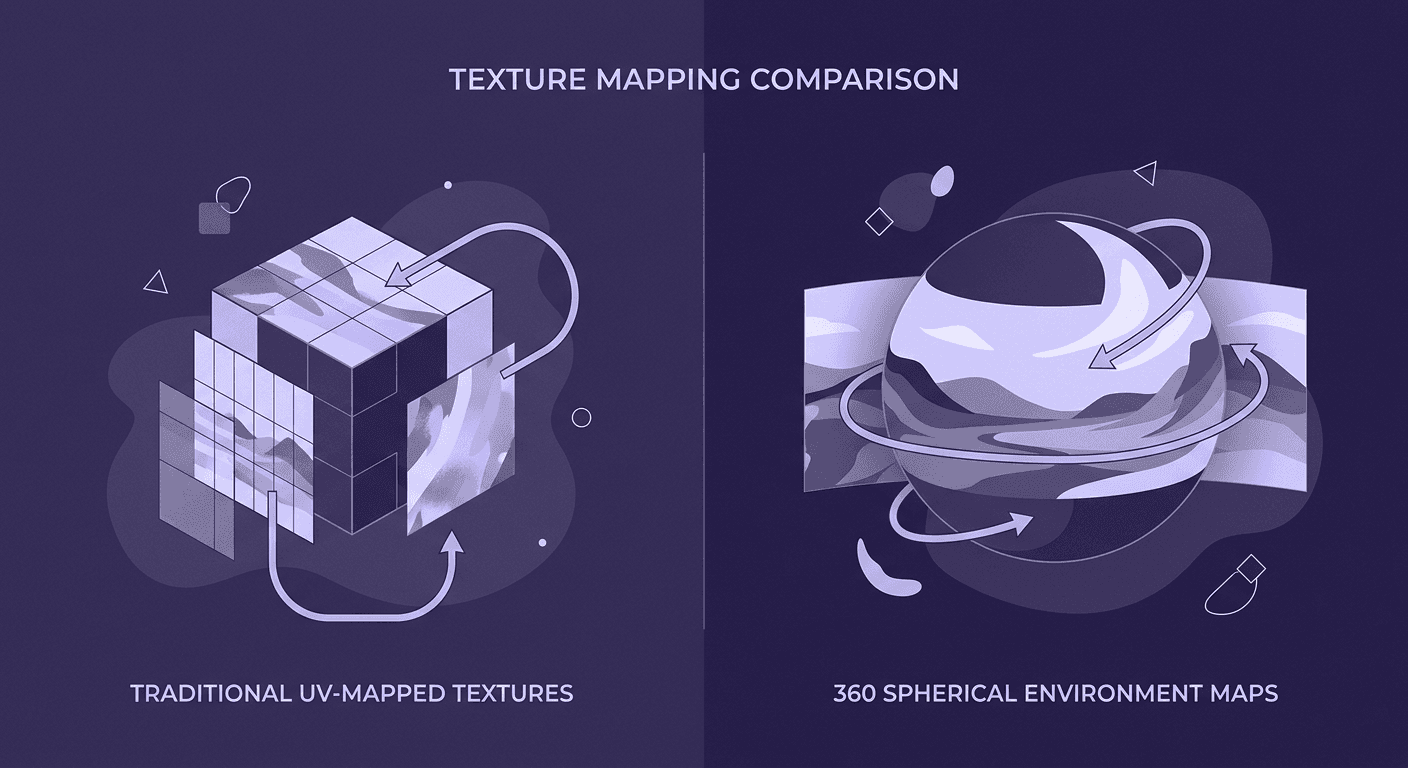
This article provides a detailed comparison between 360 environment textures and traditional textures, breaking down how they work, where they excel, and their limitations. By understanding these differences, creators can make more informed decisions about which approach, or combination of approaches, best suits their project requirements.
Understanding traditional textures in 3D design
What are traditional textures and how are they applied to 3D models?
Traditional textures are 2D image maps applied to the surface of 3D models to define their visual appearance. These textures are mapped using UV coordinates, which unwrap a 3D object into a 2D space, allowing artists to paint or project details onto it. This approach gives precise control over how every surface of an object looks, from color and roughness to fine surface imperfections.
This object-centric method is fundamental in 3D design because it allows each asset to be uniquely detailed and customized. Whether it's a character, product, or environmental prop, traditional textures ensure that every element can be fine-tuned independently within a scene.
Key texture maps used in traditional workflows
Modern traditional texturing relies heavily on Physically Based Rendering (PBR), which uses multiple texture maps to simulate realistic material behavior:
- Albedo (Diffuse) map: Defines the base color without lighting
- Normal map: Adds surface detail without increasing geometry
- Roughness map: Controls how matte or glossy a surface appears
- Metallic map: Determines how a surface interacts with light as a metal or non-metal
These maps work together to produce materials that respond accurately to lighting conditions, making traditional textures highly effective for realistic rendering.
Where traditional textures are most commonly used
Traditional textures are widely used across industries where detailed asset creation is required. In games, they define characters, props, and environments at a granular level. In animation and film, they contribute to high-quality visual storytelling. In product rendering and e-commerce, they help achieve photorealistic representations of materials like fabric, metal, and plastic.
Their versatility makes them a core component of nearly every 3D pipeline, especially when individual asset control is essential.
Advantages of traditional textures: Control, flexibility, and optimization
One of the biggest strengths of traditional textures is control. Artists can adjust specific areas of a model without affecting the entire scene, enabling precise artistic direction. This flexibility is crucial in projects that require iterative changes or client-driven revisions.
From a technical perspective, traditional textures are also easier to optimize. Since they are applied per object, resolution and detail can be adjusted based on importance and visibility. This makes them more efficient for real-time applications, where performance constraints must be carefully managed.
Overall, traditional textures provide a balanced combination of artistic freedom and technical efficiency, making them indispensable in 3D design workflows.
Understanding 360 environment textures and HDRI mapping
What are 360 environment textures and how do they work?
360 environment textures are spherical images that wrap around an entire scene, creating a fully immersive background and lighting source. Unlike traditional textures that are applied to individual objects, these textures are mapped onto a virtual sphere or dome surrounding the scene, allowing users to view the environment in all directions.
Most commonly, these textures are used in the form of HDRI (High Dynamic Range Imaging), which captures real-world lighting data across a wide range of brightness levels. This enables more accurate representation of light intensity, color, and reflections, making scenes feel more natural and grounded.
How spherical mapping and HDRI enhance lighting and reflections
One of the key strengths of 360 environment textures lies in their ability to drive realistic lighting. Because HDRI maps contain real-world light information, they can illuminate a scene with natural light direction, soft shadows, and accurate reflections, all without the need for complex manual lighting setups.
Reflections, in particular, benefit significantly from environment maps. Surfaces like metal, glass, and polished materials reflect the surrounding 360 texture, adding depth and realism that would be difficult to achieve with standard lighting alone. This makes HDRI-based workflows highly efficient for achieving photorealistic results.
Common use cases in VR, metaverse, and virtual production
360 environment textures are widely used in immersive applications where environmental context is critical. In VR and metaverse experiences, they create a sense of presence by surrounding users with a continuous visual world. In virtual production, HDRI maps are used to match real-world lighting conditions, helping blend CGI with live-action footage seamlessly.
They are also commonly used in product visualization, where a high-quality environment map can instantly enhance reflections and lighting without building a full 3D scene.
Advantages of 360 textures: Realistic lighting, depth, and immersion
The primary advantage of 360 environment textures is their ability to deliver instant realism. By capturing real-world lighting and surroundings, they provide depth and atmosphere with minimal setup. This significantly reduces production time while maintaining high visual quality.
Additionally, they enhance immersion by creating a cohesive environment that users can explore visually in all directions. This makes them particularly valuable in applications where user experience and environmental storytelling are key priorities.
However, while they excel at global lighting and atmosphere, they are not a replacement for detailed object-level texturing, highlighting the complementary nature of 360 and traditional textures.
360 environment textures vs traditional textures: Key differences explained
Object-based mapping vs full-environment mapping techniques
The most fundamental difference lies in how these textures are applied. Traditional textures are mapped directly onto individual 3D objects using UV coordinates, giving artists precise control over each asset. In contrast, 360 environment textures are mapped onto a surrounding sphere or dome, influencing the entire scene at once.
This means traditional textures operate at a micro level, defining surface details, while 360 textures function at a macro level, shaping the overall environment and lighting context.
Surface detail vs environmental context: Different roles in scene building
Traditional textures are responsible for material definition, how an object looks and feels up close. They define surface qualities like roughness, scratches, and color variation. Without them, objects would appear flat and unrealistic.
On the other hand, 360 environment textures provide context. They establish where the scene exists, whether it’s a studio, outdoor landscape, or urban setting. They influence how light behaves across objects and how reflections are perceived, adding a layer of realism that goes beyond individual assets.
Impact on visual realism and user immersion
Both texture types contribute to realism, but in different ways. Traditional textures enhance realism through detail and material accuracy, making objects believable during close inspection. 360 textures enhance realism through environmental coherence, ensuring that lighting and reflections align with a consistent world.
When used together, they significantly improve immersion. Without traditional textures, objects lack depth. Without 360 textures, scenes lack atmosphere. The absence of either creates an incomplete experience.
Performance and optimization considerations in real-time rendering
From a performance perspective, traditional textures can be optimized per asset, allowing for fine control over memory usage. Techniques like LODs, mipmaps, and selective resolution scaling make them adaptable to real-time constraints.
360 environment textures, especially high-resolution HDRIs, can be memory-intensive. While they reduce the need for complex lighting setups, they must be carefully managed to avoid performance bottlenecks, particularly in VR and web-based applications.
Flexibility, editability, and creative control compared
Traditional textures offer high flexibility. Artists can edit specific parts of a model, iterate quickly, and customize materials extensively. This makes them ideal for projects requiring detailed control and frequent revisions.
In contrast, 360 environment textures are less flexible. Since they are often captured from real-world environments or pre-rendered scenes, modifying them can be challenging. Adjustments are usually limited to rotation, exposure, or color grading rather than structural changes.
This difference makes traditional textures more suitable for detailed asset creation, while 360 textures excel in quickly establishing realistic environments with minimal setup.
Choosing the right texture approach for your project
When traditional textures are the better choice
Traditional textures are the preferred choice when your project requires detailed control over individual assets. If users are expected to interact closely with objects, such as in games, product configurators, or character-driven experiences, surface-level accuracy becomes critical. In these cases, traditional PBR textures ensure materials look believable from every angle and distance.
They are also more suitable when customization is required. Projects that involve frequent design changes, client revisions, or unique asset creation benefit from the flexibility that traditional textures provide. This makes them essential for pipelines where iteration speed and artistic precision are priorities.
When to use 360 environment textures for maximum impact
360 environment textures are ideal when the goal is to establish a realistic environment quickly and efficiently. They are particularly effective in scenarios where lighting and reflections play a major role, such as product visualization, architectural previews, and virtual showrooms.
In VR and metaverse experiences, they help create a sense of presence by surrounding users with a continuous visual environment. If the focus is on atmosphere rather than object-level detailing, 360 textures can deliver high impact with relatively low setup effort.
Combining both for hybrid workflows and better results
In most modern workflows, the best results come from combining both approaches. Traditional textures handle the fine details of objects, while 360 environment textures provide global lighting and environmental context. This hybrid approach allows creators to achieve both micro-level realism and macro-level immersion.
For example, in a product rendering scene, a high-quality HDRI environment can provide realistic reflections and lighting, while detailed PBR textures ensure the product itself looks accurate and premium. This combination maximizes visual quality without unnecessarily increasing production complexity.
Practical use cases across industries
Different industries leverage these texture types in distinct ways. In gaming, traditional textures dominate asset creation, while environment maps are used for lighting and skyboxes. In e-commerce, 360 textures enhance product presentation through realistic reflections, while traditional textures define product materials.
In architecture and virtual production, HDRI environments are often used to simulate real-world lighting conditions, while traditional textures bring structural elements to life. In VR and metaverse platforms, both approaches work together to create immersive, interactive experiences.
Ultimately, choosing the right approach depends on the project’s goals, platform constraints, and level of realism required. Understanding when and how to use each texture type is key to building efficient and visually compelling scenes.
Limitations and challenges of each texture type
Limitations of traditional textures in large-scale environments
While traditional textures offer precision and control, they can become inefficient when dealing with large-scale environments. Covering expansive scenes requires multiple textures across numerous assets, which increases production time and asset management complexity. Maintaining consistent texel density and visual coherence across a large number of objects can also be challenging, especially in team-based workflows.
Additionally, traditional textures do not inherently provide environmental context. Without proper lighting and environment setup, even well-textured objects can appear disconnected or unrealistic within a scene.
Challenges of 360 textures: File size, control, and customization
360 environment textures, particularly HDRIs, come with their own set of limitations. High-quality HDRI maps are often large in file size, which can impact memory usage and loading times, especially in real-time applications like VR or web-based experiences.
Another key limitation is control. Since these textures are typically captured from real-world environments or pre-rendered scenes, modifying specific elements within them is difficult. Artists cannot easily adjust individual components such as light sources or background objects without extensive editing or recreating the environment entirely.
Technical constraints in real-time engines (Unity, Unreal)
Both texture types must operate within the constraints of real-time rendering engines like Unity and Unreal. Traditional textures require careful optimization through mipmaps, compression, and LOD systems to maintain performance. Poor management can lead to increased draw calls and memory bottlenecks.
For 360 textures, the challenge lies in balancing resolution with performance. High-resolution HDRIs improve lighting accuracy but can strain GPU memory. Additionally, improper use can result in flat lighting if not combined with supplementary light sources.
Understanding these constraints is essential for building efficient pipelines. Without proper optimization and planning, both texture approaches can introduce performance issues that negatively impact the user experience.
Future trends in texture and environment design
AI-generated and procedural texture workflows
The integration of AI into texture creation is reshaping how environments are built. Tools can now generate seamless textures, upscale low-resolution assets, and even create full environment maps from minimal input. Procedural systems further enhance this by allowing textures to be dynamically generated and modified in real time.
For creators, this means faster production cycles and greater scalability. Instead of manually crafting every texture, teams can automate repetitive tasks while focusing on creative direction. This is particularly valuable in large metaverse environments where asset volume is high.
Real-time environment rendering and dynamic lighting advances
Advancements in real-time rendering are reducing the gap between pre-rendered and interactive experiences. Technologies like real-time global illumination and dynamic reflections are making environments more responsive and lifelike.
This evolution impacts both traditional and 360 textures. Traditional textures benefit from more accurate lighting interaction, while 360 environment textures are being supplemented, or in some cases replaced, by dynamic sky and lighting systems that adapt in real time. The result is a more flexible and immersive visual experience.
The growing importance of 360 textures in the metaverse and VR
As the metaverse continues to expand, the demand for immersive, full-environment experiences is increasing. 360 textures play a key role in delivering this immersion, especially in applications where users are free to explore environments in all directions.
At the same time, the expectation for quality is rising. Users now expect not just immersive environments, but also high levels of detail and realism. This reinforces the need for hybrid approaches, where 360 textures provide environmental context and traditional textures ensure detailed, interactive assets.
For forward-looking teams, staying competitive means adopting these evolving workflows and continuously refining how textures are created, optimized, and integrated.
Choosing the right texture strategy for modern workflows
360 environment textures and traditional textures serve fundamentally different but complementary roles in 3D design. Traditional textures provide detailed control over individual assets, while 360 textures define the surrounding environment, lighting, and overall atmosphere. Understanding these differences is essential for building visually compelling and technically efficient scenes.
Rather than choosing one over the other, the most effective approach is often a strategic combination of both. By leveraging traditional textures for precision and 360 textures for immersion, creators can achieve a balanced workflow that maximizes realism without compromising performance.
As technology continues to evolve, the ability to adapt texture strategies will become increasingly important. Those who understand when and how to use each approach will be better equipped to create high-quality, scalable, and immersive experiences across gaming, VR, and the metaverse.

Max Calder
Max Calder is a creative technologist at Texturly. He specializes in material workflows, lighting, and rendering, but what drives him is enhancing creative workflows using technology. Whether he's writing about shader logic or exploring the art behind great textures, Max brings a thoughtful, hands-on perspective shaped by years in the industry. His favorite kind of learning? Collaborative, curious, and always rooted in real-world projects.
Latest Blogs
The Indie Dev Guide to CC0 PBR Textures: Stop Searching, Start Cr...
PBR textures
AI in 3D design

Mira Kapoor
Jul 10, 2026
Sourcing Free Game Textures: Navigating PBR Pipelines and Stylize...
PBR textures
Game textures
Mira Kapoor
Jul 6, 2026
Sculpting with Sunlight: The Architectural Physics of Facade Text...
Texture creation
AI in 3D design

Max Calder
Jul 1, 2026

Accelerate you workflow
with automated PBR texture generation
Enjoy creative freedom with AI powered texture creation
 Texturly
Copyright © 2026 Texturly, Asha Technology Labs Pvt. Ltd. All rights reserved