A Practical Guide for How to Choose The Right Concrete Texture for Your Project
By Mira Kapoor | 29 April 2026 | 10 mins read
Table of contents
Table of Contents
Concrete is one of the most widely used materials in architecture, yet its visual impact is often underestimated. In both real-world projects and architectural visualization (archviz), the choice of concrete texture can dramatically influence how a space feels, whether it appears warm or cold, refined or raw, modern or industrial. What may seem like a simple gray surface is actually a complex material with variations in finish, depth, and light interaction.
For architects and 3D artists, selecting the right concrete texture is not just an aesthetic decision; it’s a strategic one. The same surface can behave very differently depending on lighting, scale, and context. A polished concrete floor in a luxury interior demands a completely different texture approach than an exposed concrete wall in a brutalist exterior. Without careful selection, textures can feel repetitive, unrealistic, or disconnected from the overall design intent.
This guide breaks down how to choose the right concrete texture for your project by focusing on practical factors like usage, style, lighting, and performance. Whether you’re designing a real-world space or building a high-quality archviz scene, understanding these variables will help you make more confident and effective texture decisions.
Understanding concrete textures: Types and characteristics
Smooth vs Rough concrete: Surface finish differences explained
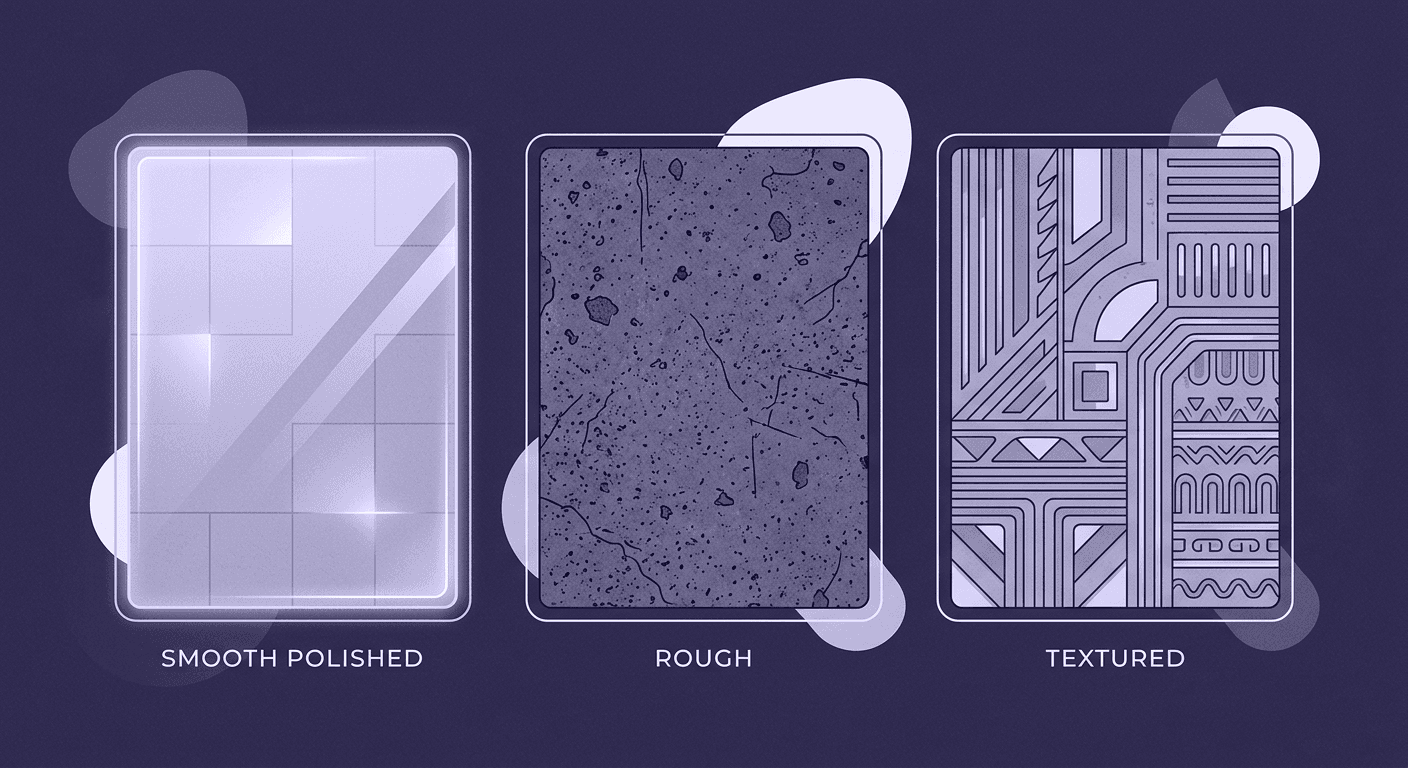
Concrete textures vary widely based on how the surface is finished. Smooth concrete is typically achieved through polishing or careful casting, resulting in a clean, refined look with subtle reflectivity. It is commonly used in modern interiors, galleries, and commercial spaces where a sleek aesthetic is required.
Rough concrete, on the other hand, retains more surface irregularities, visible pores, grain, and imperfections. This type of texture is often associated with raw, industrial, or brutalist architecture. It adds visual weight and tactile realism, especially in large-scale exterior applications. Choosing between smooth and rough finishes depends heavily on the mood and function of the space.
Polished, brushed, stamped, and exposed aggregate textures
Beyond basic smooth and rough categories, concrete textures can be further refined into specific finishes:
- Polished concrete: Highly refined with a glossy or semi-gloss finish, often used in high-end interiors
- Brushed concrete: Subtle directional texture created by brushing the surface, adding grip and visual interest
- Stamped concrete: Designed to mimic other materials like stone or brick, commonly used in outdoor applications
- Exposed aggregate: Reveals embedded stones within the concrete, creating a textured and decorative surface
Each of these finishes serves a different purpose, both functionally and visually, making it important to align the texture type with the project’s requirements.
Real-world vs Digital (PBR) concrete textures in archviz
In architectural visualization, concrete textures are typically represented using Physically Based Rendering (PBR) workflows. These include multiple maps, albedo, normal, roughness, and displacement, which simulate how real concrete interacts with light.
Unlike real-world concrete, which naturally varies due to environmental factors, digital textures must be intentionally designed to include imperfections. Without these variations, surfaces can appear too uniform and artificial. High-quality PBR textures bridge this gap by replicating real-world characteristics such as stains, cracks, and subtle tonal shifts.
Key properties: Porosity, reflectivity, and wear patterns
To choose the right concrete texture, it’s important to understand its core material properties:
- Porosity: Determines how much moisture or dirt the surface absorbs, affecting appearance over time
- Reflectivity: Influences how light interacts with the surface; polished concrete reflects more light, while rough concrete diffuses it
- Wear Patterns: Include cracks, stains, and surface erosion that add realism and context
These properties play a crucial role in both real-world durability and visual authenticity in archviz. A well-chosen texture doesn’t just look right; it behaves convincingly within its environment.
Key factors to consider when choosing concrete textures
Project type: Interior vs Exterior applications
The intended use of the space is one of the most important factors in selecting a concrete texture. Interior applications typically require smoother, more controlled finishes such as polished or lightly brushed concrete. These surfaces reflect light more evenly and contribute to a cleaner, more refined aesthetic, ideal for residential interiors, offices, and retail environments.
Exterior applications, however, demand more durability and visual variation. Rougher textures like exposed aggregate or unfinished concrete are better suited for outdoor conditions, as they handle weathering more effectively and provide natural grip. In Archviz, this distinction is equally important; using an overly polished texture in an exterior scene can feel unrealistic and break visual credibility.
Scale and viewing distance in architectural visualization
In Archviz, texture selection must account for how close the viewer will be to the surface. Large surfaces like walls or floors require textures with consistent detail and proper scaling to avoid stretching or repetition. If the texel density is too low, the surface will appear blurry; if it’s too high, it may look unnaturally sharp or tiled.
Close-up shots, such as interior renders or product-focused scenes, require high-resolution textures with visible micro-details. For distant views, such as building exteriors, lower detail may suffice, but consistency must still be maintained across the scene.
Lighting conditions and material interaction
Concrete is highly responsive to lighting, and the same texture can look dramatically different under varying conditions. Natural daylight tends to highlight surface imperfections and tonal variation, while artificial lighting can emphasize reflectivity and smoothness.
For example, polished concrete under strong directional lighting will produce noticeable reflections, while rough concrete will diffuse light and create softer shadows. When choosing a texture, it’s essential to consider how it will interact with the scene’s lighting setup, both in real-world design and in rendered environments.
Climate and environmental exposure in real-world projects
In real-world applications, environmental factors such as moisture, temperature changes, and wear over time influence how concrete behaves. Outdoor concrete surfaces often develop stains, cracks, and discoloration due to weather exposure.
While this may not physically affect digital scenes, incorporating these environmental cues in archviz adds realism. A perfectly clean, uniform concrete surface in an outdoor setting can feel artificial. Adding subtle wear patterns aligned with the environment helps ground the scene in reality.
By evaluating these factors, usage, scale, lighting, and environment, you can make more informed decisions that align with functional requirements and visual authenticity.
Matching concrete textures to design style
Minimalist and modern architecture: Clean and polished surfaces
In minimalist and modern design, simplicity and precision are key. Concrete textures used in these spaces are typically smooth, polished, and uniform, with minimal visual noise. The goal is to create a clean, uninterrupted surface that complements open layouts and neutral color palettes.
In Archviz, this means using high-quality polished concrete textures with subtle variation, just enough to avoid looking flat, but not so much that it distracts from the overall composition. Controlled reflectivity and soft tonal shifts help maintain realism while preserving the minimalist aesthetic.
Industrial and brutalist styles: Raw and rough concrete
Industrial and brutalist architecture embraces the raw nature of materials, and concrete plays a central role in defining this aesthetic. Rough, unfinished textures with visible pores, seams, and imperfections are essential for achieving this look.
These textures add depth and character, especially in large-scale structures where uniform surfaces would feel lifeless. In archviz, incorporating variation, such as stains, patchiness, and slight discoloration, helps reinforce authenticity. The key is to make the surface feel naturally imperfect rather than artificially distressed.
Luxury and commercial spaces: Refined and treated finishes
In high-end residential or commercial environments, concrete is often treated to achieve a more refined appearance. This includes polished finishes, sealed surfaces, or decorative techniques like stamping and staining.
These textures strike a balance between realism and sophistication. They retain the material identity of concrete while elevating its visual appeal. In visualization projects, attention to reflectivity and lighting becomes critical, as these surfaces are often designed to interact with ambient light in a controlled way.
Blending concrete with other materials (wood, glass, metal)
Concrete rarely exists in isolation; it is often paired with materials like wood, glass, or metal to create contrast and balance. The choice of concrete texture should complement these materials rather than compete with them.
For example, a rough concrete wall can be balanced with warm wooden elements, while polished concrete floors pair well with glass and steel in modern interiors. In Archviz, achieving this harmony requires careful coordination of texture detail, color tone, and reflectivity across all materials in the scene.
Matching concrete textures to the overall design style ensures that they contribute meaningfully to the visual narrative, rather than feeling like an afterthought.
Performance and practical considerations
Durability and maintenance in real-world applications
In physical construction, the choice of concrete texture has direct implications for durability and maintenance. Smooth, polished surfaces are easier to clean and maintain, making them suitable for interiors and high-traffic commercial spaces. However, they can show scratches and wear more visibly over time.
Rougher textures, such as exposed aggregate or brushed finishes, are more forgiving in outdoor environments. They provide better grip and are less likely to reveal minor wear, but they can accumulate dirt more easily. Understanding these trade-offs helps ensure that the selected texture aligns with both functional requirements and long-term usability.
Texture optimization for archviz (resolution, tiling, PBR maps)
In architectural visualization, performance is driven by how efficiently textures are used. High-resolution textures improve realism, especially for close-up renders, but they also increase memory usage and render times. The goal is to use the right resolution where it matters most, typically for focal areas, while optimizing secondary surfaces.
Proper tiling is equally important. Poorly tiled concrete textures can create visible repetition, breaking realism. Using high-quality, seamless PBR textures with variation maps (such as roughness and normal) helps maintain a natural look across large surfaces.
Avoiding repetition and achieving realism in large surfaces
Concrete is often used across expansive areas, floors, walls, and facades, which makes repetition one of the biggest challenges. When the same texture pattern repeats too obviously, it creates a synthetic look that undermines the entire scene.
To avoid this, techniques such as texture blending, decals (for stains and cracks), and variation masks can be used. Even subtle changes in tone or roughness can significantly improve realism. The objective is to mimic how concrete behaves in the real world, never perfectly uniform, always slightly varied.
Balancing practical considerations with visual quality ensures that your concrete textures not only look good but also perform efficiently, whether in real-world construction or high-end architectural visualization.
Common mistakes when selecting concrete textures
Ignoring scale and texture density
One of the most frequent and visually damaging mistakes is incorrect texture scaling. A concrete texture might be high resolution and well-crafted, but if the scale is off relative to the object, the entire scene can feel unrealistic. For example, if the grain size of the concrete appears too large, it can make a wall look miniature; if it’s too fine, the surface may appear unnaturally smooth or plastic-like.
In architectural visualization, maintaining consistent texel density across all surfaces is critical. This means that textures should have a uniform level of detail relative to their size in the scene. When multiple materials are used together, such as concrete with wood or metal, any inconsistency in scale becomes immediately noticeable. This issue often arises when textures are applied without proper UV mapping or when default scaling values are used without adjustment.
To avoid this, always validate texture scale in real-world units. Compare your texture against reference objects such as doors, tiles, or human-scale objects. A well-scaled texture ensures that surfaces feel believable and proportionate, which is essential for both realism and professional-quality output.
Overusing perfect, unrealistic surfaces
Another common mistake is relying on overly clean and flawless concrete textures. While these may look appealing in isolation, they rarely exist in real-world environments. Concrete naturally develops variations due to casting, curing, environmental exposure, and usage over time. These include subtle stains, discoloration, hairline cracks, and uneven tonal patches.
In Archviz, using perfectly uniform textures can make a scene feel sterile and artificial, especially in large surfaces like walls or floors. Even in modern or luxury spaces where concrete is polished, there are still micro-imperfections that give the material authenticity. The absence of these details removes the tactile realism that users subconsciously expect.
The solution is to introduce controlled variation. This doesn’t mean overloading the texture with damage or dirt, but rather adding subtle imperfections that align with the environment. Techniques like blending multiple texture maps, adding decals, or using variation masks can help break uniformity while maintaining design intent. The goal is to strike a balance, clean but believable.
Mismatched lighting and material response
Concrete is highly sensitive to lighting, and mismatches between texture properties and lighting conditions can quickly break realism. For instance, a rough concrete surface should diffuse light and appear matte, while polished concrete should reflect light more clearly. If these properties are incorrectly configured, such as a rough surface appearing glossy, the material will feel visually incorrect.
This issue often arises from improper roughness or specular map settings in PBR workflows. Even a well-made texture can look wrong if these maps are not calibrated correctly within the rendering engine. Additionally, different lighting setups, natural daylight, HDRI environments, or artificial lighting can dramatically change how a texture appears.
To address this, always test materials under the final lighting conditions of your scene. Adjust roughness and reflectivity values to match real-world behavior. Observing how light interacts with reference materials can help guide these adjustments. Consistency between material properties and lighting is essential for achieving a convincing result.
Choosing style over function
A common strategic mistake is prioritizing aesthetics without considering functionality, or focusing too much on function at the expense of design intent. For example, selecting a highly polished concrete texture for an outdoor walkway may look visually appealing, but it would be impractical in real-world conditions due to slip risks. Similarly, using a rough, industrial texture in a luxury interior may conflict with the desired atmosphere.
In Archviz, this mismatch can lead to scenes that feel visually inconsistent or conceptually weak. The texture should not only look good but also make sense within the context of the space. It should align with how the environment is used, the type of project, and the overall design language.
The best approach is to evaluate both aspects simultaneously. Ask whether the texture supports the functional requirements of the space while also enhancing its visual identity. When both factors are aligned, the result is a cohesive and believable design that resonates with viewers and clients alike.
Best practices for choosing the right concrete texture
Start with reference and real-world inspiration
Every strong material decision begins with observation. Before selecting or creating a concrete texture, it’s essential to study real-world references. This includes photographs of buildings, interiors, construction sites, and surfaces under different lighting conditions. Observing how concrete behaves in various environments provides valuable insight into its natural variation, wear patterns, and interaction with light.
For archviz artists, creating a reference board or mood board can significantly improve decision-making. This helps define the visual direction early in the project and ensures that all material choices are aligned with the intended style. References also reduce reliance on guesswork, allowing for more accurate and confident texture selection.
Additionally, references help identify subtle details that are often overlooked, such as edge wear, formwork marks, or slight color shifts. Incorporating these nuances into your textures can elevate the realism of your project.
Test textures in lighting and scene
A texture should never be evaluated in isolation. What looks correct in a material preview or texture viewer may behave very differently when applied to a full scene. Factors like lighting, scale, camera angle, and surrounding materials all influence how a texture is perceived.
Testing textures in context means applying them to actual geometry and evaluating them under the final lighting setup. This includes checking for issues such as incorrect scaling, visible tiling, unrealistic reflectivity, or lack of variation. It’s also important to view the texture from multiple distances, close-up and from afar, to ensure consistency.
Iteration is key in this process. Small adjustments to roughness, color balance, or tiling can make a significant difference. By continuously testing and refining, you can ensure that the texture integrates seamlessly into the scene and contributes to overall realism.
Use high-quality, tileable PBR textures
The foundation of realistic concrete surfaces lies in high-quality PBR textures. These textures include multiple maps, albedo, normal, roughness, and sometimes displacement, that work together to simulate how the material interacts with light.
Tileability is especially important for concrete, as it is often used across large surfaces. A non-tileable texture will create visible seams, breaking immersion. High-quality tileable textures are designed to repeat seamlessly, allowing them to cover large areas without noticeable patterns.
However, even tileable textures can become repetitive if used alone. To enhance realism, consider layering additional detail through decals, variation maps, or blending techniques. This helps introduce uniqueness across the surface while maintaining performance efficiency.
Build a consistent material library for projects
Consistency is a key factor in maintaining quality across a project, especially in professional or team-based workflows. Building a curated material library allows you to standardize textures in terms of resolution, scale, and style. This ensures that all surfaces within a project feel cohesive and aligned.
A well-organized library also improves efficiency. Instead of searching for new textures for every project, you can rely on a set of tested, high-quality materials. Over time, this library becomes a valuable asset, enabling faster iteration and more consistent results.
For studios and teams, establishing guidelines for texture usage, such as naming conventions, resolution standards, and PBR calibration, can further enhance workflow efficiency. This structured approach not only saves time but also ensures that every project meets a consistent level of visual quality.
Making confident texture decisions for better results
Choosing the right concrete texture is not just about aesthetics; it’s about aligning material properties with the purpose, environment, and design intent of your project. From understanding different texture types to considering factors like scale, lighting, and performance, each decision contributes to how a space is ultimately perceived.
For architects and archviz artists, the most effective approach is a balanced one. Combine visual quality with practical considerations, use references to guide decisions, and always evaluate textures in context. Small adjustments in texture choice can have a significant impact on realism and overall design coherence.
As projects become more complex and expectations for visual fidelity continue to rise, mastering texture selection becomes a critical skill. With the right approach, concrete, one of the simplest materials, can become one of the most powerful tools in your design process.

Mira Kapoor
Mira leads marketing at Texturly, combining creative intuition with data-savvy strategy. With a background in design and a decade of experience shaping stories for creative tech brands, Mira brings the perfect blend of strategy and soul to every campaign. She believes great marketing isn’t about selling—it’s about sparking curiosity and building community.
Latest Blogs

The Indie Dev Guide to CC0 PBR Textures: Stop Searching, Start Cr...
PBR textures
AI in 3D design

Mira Kapoor
Jul 10, 2026
Sourcing Free Game Textures: Navigating PBR Pipelines and Stylize...
PBR textures
Game textures
Mira Kapoor
Jul 6, 2026
Sculpting with Sunlight: The Architectural Physics of Facade Text...
Texture creation
AI in 3D design

Max Calder
Jul 1, 2026

Accelerate you workflow
with automated PBR texture generation
Enjoy creative freedom with AI powered texture creation
 Texturly
Copyright © 2026 Texturly, Asha Technology Labs Pvt. Ltd. All rights reserved