From Trowel to Render: How Real Concrete Craft Creates Better CG
By Max Calder | 25 February 2026 | 15 mins read
Table of contents
Table of Contents
Most digital concrete textures feel dead on arrival. They’re flat, lifeless images slapped onto a model, a generic gray slab that does nothing to sell the design. You’ve scrolled through the libraries, you’ve tweaked the maps, and you know there’s a massive gap between the asset on your screen and the real-world material. This guide is here to bridge that gap. We’re going to unpack the most common concrete textures, not just what they are, but the craft behind how they’re made, and then give you a practical framework for translating that knowledge into a high-fidelity digital material library. Because when you understand the physical process, from a simple broom finish to a multi-stage polish, you gain the insight needed to create assets that feel authentic, saving time and making your visualizations far more convincing.
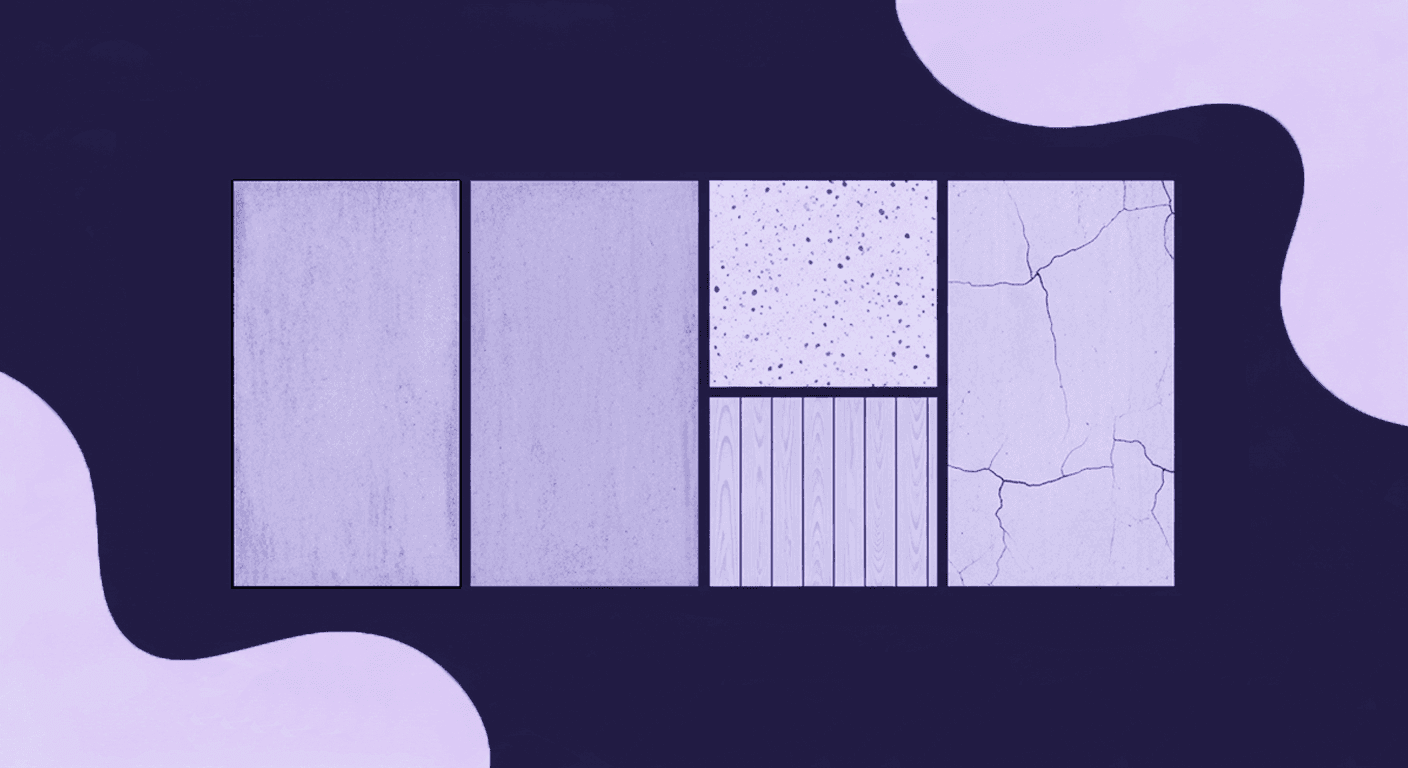
The foundation: A field guide to concrete wall textures
When most people think of concrete, they picture a flat, gray, utilitarian slab. But that’s like saying all you can do with flour is make plain bread. Concrete is a canvas, and its texture is the brush stroke that defines the final piece. Understanding the different finishes is the first step to using them with intent, both in the real world and in your digital models.
Breaking down the most popular concrete texture styles
Think of these as your starter kit. Each one has a distinct personality and a specific job to do.
Smooth and polished finishes: The minimalist's choice
This is the clean, crisp look you see in modern art galleries and high-end retail. It’s achieved by meticulously grinding and polishing the concrete surface with progressively finer diamond abrasives until it reflects light like a calm lake. The goal here is subtlety. A polished finish isn’t just about being shiny; it’s about creating a surface so perfect that it highlights the form of the architecture around it. In a render, this means your roughness map is king. It’s not a uniform gloss; it has subtle variations that catch the light and prove it’s a real-world material, not a plastic toy.
Broom and brushed finishes: Adding subtle depth and grip
Simple, effective, and incredibly common. This texture is created by dragging a specialized broom or brush across the surface of freshly poured concrete. The result is a series of fine, parallel lines that break up the flatness and provide a bit of tooth. It’s a workhorse finish, often used on exterior walkways for slip resistance, but it can bring a subtle, handcrafted feel to a wall. Digitally, this texture is all about the normal map. A simple gray albedo map won’t cut it; you need those fine-grained lines to catch the light at grazing angles to sell the effect.
Stamped and imprinted patterns: Mimicking stone, brick, and wood
This is where concrete becomes a chameleon. Using flexible polyurethane stamps or rigid form liners, you can imprint the surface of wet concrete to mimic almost any material: slate, cobblestone, brick, or even detailed wood grain from board-forming. This technique is a game-changer for getting high-end looks on a real-world budget. For visualization pros, these surfaces are where displacement and height maps are non-negotiable. You need to create real geometric depth so the shadows have something to grab onto. A flat texture of a brick pattern looks fake from any angle but straight on. A displacement map makes it feel real enough to touch.
Exposed aggregate surfaces: The raw, natural look
This finish celebrates the ingredients of concrete itself. By using a chemical surface retarder or light abrasive blasting, the top layer of cement paste is removed to reveal the sand and gravel (the aggregate) within the mix. The result is a durable, highly textured surface with a natural, almost geological feel. No two exposed aggregate surfaces are identical, which is both their charm and their challenge. Capturing this digitally means focusing on variation in the color, size, and distribution of the stones. It’s the perfect place to embrace the “happy accidents” that make materials feel authentic.
More than just looks: How concrete textures impact performance
Choosing a texture isn't just an aesthetic decision. It has real-world consequences for how the building functions and feels.
- Durability and resistance to wear: A rough, exposed aggregate finish is brilliant at hiding minor scuffs and imperfections, making it a rugged choice for high-traffic areas. A pristine, highly polished surface, on the other hand, is dense and easy to clean but will show a deep scratch like a scar. The texture dictates the maintenance plan.
- Light reflection, shadow, and visual depth: This is where the physics of light meets architectural intent. A smooth, polished wall will create sharp, specular reflections, bouncing light deep into a space. A brushed finish will catch the light and create soft, linear highlights. A deeply stamped or exposed aggregate surface creates a complex dance of tiny shadows, giving the wall a feeling of immense depth and substance. You're not just choosing a texture; you're choosing how that surface will interact with light all day long.
- Slip resistance for functional surfaces: While our focus is on walls, the principle is key. The same broom finish that keeps you from slipping on a sidewalk can be used on a low retaining wall to discourage people from sitting on it or to break up water flow down its surface. Function is always part of the conversation.
The craft: How to create different concrete wall textures
Knowing what a texture is gets you started. Knowing how it’s made is what gives you control over the final outcome, both on-site and in your material library. This is where the real craft comes in.
Unpacking the core decorative concrete techniques
These methods are part art, part science. The timing, the tools, and the mix itself all play a huge role.
- The art of the trowel: From smooth to stucco-like finishes
A simple steel trowel in a skilled hand can produce a vast range of finishes. A hard trowel finish, where the mason makes multiple passes with increasing pressure as the concrete sets, creates that dense, smooth surface perfect for polishing. But you can also get more artistic. A “skip trowel” technique involves flicking a thin layer of plaster-like material over the surface, creating a random, stucco-like texture. It’s all about timing and touch. - Stamping and form liners: A technical guide for crisp patterns
This is a process of precision. For a crisp imprint, you need three things: a quality stamp or form liner (often made of durable polyurethane), a good release agent (a bond-breaker that keeps the stamp from pulling up the concrete), and perfect timing. Stamp too early, and the wet concrete will slump back on itself, blurring the details. The stamp is too late, and the hardened surface won't take the impression. Form liners, which are fixed to the inside of the concrete forms before the pour, offer more control and are fantastic for large-scale, repeatable patterns like board-form. - Abrasive blasting and chemical retarders for exposed aggregate
There are two main paths to an exposed aggregate finish. The first is subtractive: you wait for the concrete to cure, then use abrasive blasting (like sandblasting or shotblasting) to physically erode the surface paste. This gives you a lot of control over the depth of the reveal. The second method is chemical. You apply a chemical retarder to the surface of the wet concrete. This chemical slows down the curing process for the top 1/8 inch of paste. The next day, you can come back and wash it away with a pressure washer, revealing the aggregate beneath. This often results in a more natural, river-rock look. - Grinding and polishing for a high-gloss concrete surface finish
This isn't a single step; it's a multi-stage process. You start with a heavy, planetary grinder and coarse-grit (maybe 30-40 grit) metal-bonded diamond abrasives to expose the sand and aggregate. From there, you work your way up through progressively finer grits, 80, 150, 200, 400, often applying a chemical densifier along the way to harden the surface. The final polishing stages use very fine resin-bonded diamonds (800, 1500, and even 3000 grit) to achieve that mirror-like sheen. It’s methodical, labor-intensive, and the results are stunning.
Choosing the right concrete texture methods for your project
Okay, so you know the options. How do you choose the right one?
- Interior vs. Exterior applications and considerations: The environment is a huge factor. A deeply stamped exterior wall needs to be sealed properly to prevent water from getting into the crevices, freezing, and spalling the surface. A highly polished interior floor is beautiful, but near an exterior door in a snowy climate, it could become a slip-and-slide without the right mats.
- Balancing aesthetic goals with budget and timeline: Budget drives a lot of decisions. A simple broom finish is fast, cheap, and requires basic skills. A multi-stage polished finish or a wall requiring custom-made form liners is at the opposite end of the spectrum; it's expensive, slow, and requires specialized contractors. The key is to match the aesthetic ambition to the project's constraints.
- How the concrete mix itself influences the final texture: This is the pro-level insight most people miss. You can’t get a great, polished finish from a poor mix. A mix designed for polishing will have well-graded sand and aggregate and a lower water-to-cement ratio to create a denser slab. For an exposed aggregate finish, the choice of rock is everything. You might spec a mix with colorful river stone or recycled glass to create a one-of-a-kind look. The texture starts with the recipe.
The digital bridge: Translating physical textures to a visualization pipeline
So, you’ve got a beautiful, real-world material. Now, how do you keep it from looking like a flat, dead sticker in your renders? The translation from physical to digital is where most workflows fall apart. Let’s fix that.
Why most digital concrete materials miss the mark
We’ve all seen it: the concrete wall in a render that just feels… off. It’s usually because the material is missing the key ingredients that trick our eyes into seeing depth and realism.
- Moving beyond a simple flat image map: The most common mistake is using a single photo, the albedo or diffuse map, and calling it a day. This gives you the color, but none of the life. It’s the digital equivalent of a concrete-patterned wallpaper. It has no depth, no response to light, and it screams “CG.”
- The importance of displacement, normals, and roughness maps: Realism lives in the PBR (Physically-Based Rendering) maps. Think of them this way:
- Normal map: This is for the fine details. It fakes the tiny bumps, grooves, and pores on a surface, telling the render engine how light should bounce off at a micro-level. It’s perfect for capturing the subtle texture of a broom finish or the porosity of cast concrete.
- Roughness map: This map controls the glossiness. Is the surface a mirror-polished slab (black in the map) or a chalky, porous block (white in the map)? Most concrete is somewhere in between, with variations from dirt or moisture. A good roughness map is the secret to believable reflections.
- Displacement map: This is the heavy lifter. It actually pushes and pulls the geometry of your model at render time to create real depth. For stamped brick patterns or chunky exposed aggregate, displacement is essential. It creates real shadows and parallax effects that hold up even from close-up or oblique angles.
- Capturing the happy accidents that make real concrete unique: Perfection is boring. Real concrete has form-tie holes, subtle color shifts from uneven curing, small air bubbles (bug holes), and maybe even a faint hairline crack. The best digital materials incorporate these imperfections. They tell a story and make the surface feel like it was crafted, not generated.
A framework for digitizing architectural concrete texturing
You don’t need a multi-million dollar scanning lab to build a high-quality material library. Here are three solid approaches.
- Photogrammetry and scanning for hyper-realistic results: This is the gold standard for capturing reality. Using software like RealityCapture or Polycam, you take a series of overlapping photos of a real-world surface. The software then reconstructs the surface as a high-poly 3D model with its texture already applied. From this, you can bake out perfectly matched PBR maps. It’s data-heavy and requires some cleanup, but the results are unmatched for authenticity.
- Procedural generation: Building flexible materials from scratch: Think of this as being a digital materials scientist. Using node-based tools like Substance 3D Designer or Material Maker, you build your concrete material from the ground up using mathematical functions. The incredible advantage here is flexibility. You can expose parameters to control the aggregate size, the crack intensity, the amount of water staining, or the wood grain detail, all with a few sliders. You can generate infinite variations from one master graph. For a large firm, this is the path to a standardized, scalable library.
- Using AI to assist in texture creation and standardization: This is the new frontier, and it’s a massive workflow accelerator. AI-powered tool Texturly can take a single photo of a concrete wall and generate a full set of PBR maps. It can make a non-tileable texture seamless with the click of a button, or remove the shadows baked into a photo (a process called “de-lighting”). This isn’t about replacing artists; it’s about automating the tedious parts of the process so you can focus on the creative side.
The payoff: A better workflow for realistic renders
Getting your materials right isn’t just about making pretty pictures. It’s about building a more efficient, persuasive, and profitable workflow.
Integrating high-fidelity concrete surface treatments into your library
An amazing material that no one can find is useless. A library of assets is only as good as its organization.
- Naming conventions and organization for team-wide efficiency: Don't just save your material as Concrete_Final_02.sbsar. That’s a recipe for chaos. Implement a clear, descriptive naming convention that everyone on the team can understand. Something like CONC_Cast-in-Place_Board-Form_Light-Gray_12ft.s bsar. Include the material type, finish, color, and real-world scale. It makes searching, sharing, and managing assets a breeze.
- Building a pipeline for testing materials in VR and real-time renders: A material can look great in a thumbnail but fall apart in a real scene. Set up a standardized “look-dev” scene, a simple stage with controlled lighting (day, night, overcast) where you can drop in new materials for testing. More importantly, test them in VR. Virtual reality is the ultimate test of scale and texture. A displacement map that looks fine on a 2D screen might look like an exaggerated cartoon in a headset. Test, tweak, and approve materials before they go into a live project.
Improving client presentations and buy-in with realism
This is where all the technical work pays off. A better render isn’t just a nice-to-have; it's a powerful sales tool.
- How accurate textures make a render more convincing: When a client looks at a render, they’re trying to imagine themselves in that space. A flat, lifeless concrete texture feels fake and breaks that immersion. But a richly detailed surface that catches the light realistically makes the space feel tangible, solid, and real. It replaces intellectual understanding with an emotional connection. You stop talking about square footage and start talking about how the morning light will feel on that feature wall.
- Case study: From a flat gray wall to a compelling architectural feature: Imagine you’re presenting a design for a modern home that features a large concrete fireplace. In the first-pass renders, it’s just a medium-gray box. It looks cold, maybe even a little cheap. The client is unsure. For the next review, you swap it out for a high-fidelity, board-formed concrete material. Suddenly, you can see the faint imprint of the wood grain, the subtle variations in color, and the way light creates soft shadows across its surface. The fireplace is no longer just a box; it’s a warm, tactile centerpiece. The client doesn’t just approve it, they’re excited about it. That’s the difference a great material makes.
Beyond the surface: Making your materials matter
So, we’ve gone from the real-world grit of an aggregate finish to the digital nodes of a procedural graph. The big takeaway here isn’t just a list of textures, it’s a shift in perspective. A truly great concrete material isn’t just a photorealistic image; it’s a translation of the craft itself.
Think of it this way: you’re no longer just a user of materials, you’re a digital mason. You have the insight to look at a surface and understand its story, the specific boards that left their grain behind, the trowel that skipped across the surface, or the precise grinding that created a mirror-like sheen. When you bring that understanding into your workflow, you stop just applying textures and start directing how a space should feel.
This is your new advantage. The next time a render feels flat, don’t just search for a better PBR map. Ask what story the surface needs to tell. Then, use the tools we’ve unpacked to build a library that reflects that intent, a library that becomes your firm’s unique asset. This isn’t about chasing perfect realism for its own sake. It’s about building a smarter pipeline that makes your client presentations more convincing, your team more efficient, and your work feel tangible.
Now, go build something that feels real.

Max Calder
Max Calder is a creative technologist at Texturly. He specializes in material workflows, lighting, and rendering, but what drives him is enhancing creative workflows using technology. Whether he's writing about shader logic or exploring the art behind great textures, Max brings a thoughtful, hands-on perspective shaped by years in the industry. His favorite kind of learning? Collaborative, curious, and always rooted in real-world projects.
Latest Blogs

The Indie Dev Guide to CC0 PBR Textures: Stop Searching, Start Cr...
PBR textures
AI in 3D design

Mira Kapoor
Jul 10, 2026
Sourcing Free Game Textures: Navigating PBR Pipelines and Stylize...
PBR textures
Game textures
Mira Kapoor
Jul 6, 2026
Sculpting with Sunlight: The Architectural Physics of Facade Text...
Texture creation
AI in 3D design

Max Calder
Jul 1, 2026

Accelerate you workflow
with automated PBR texture generation
Enjoy creative freedom with AI powered texture creation
 Texturly
Copyright © 2026 Texturly, Asha Technology Labs Pvt. Ltd. All rights reserved