From Faking Light to Simulating Physics: PBR vs Traditional Materials
By Max Calder | 3 December 2025 | 11 mins read
Table of contents
Table of Contents
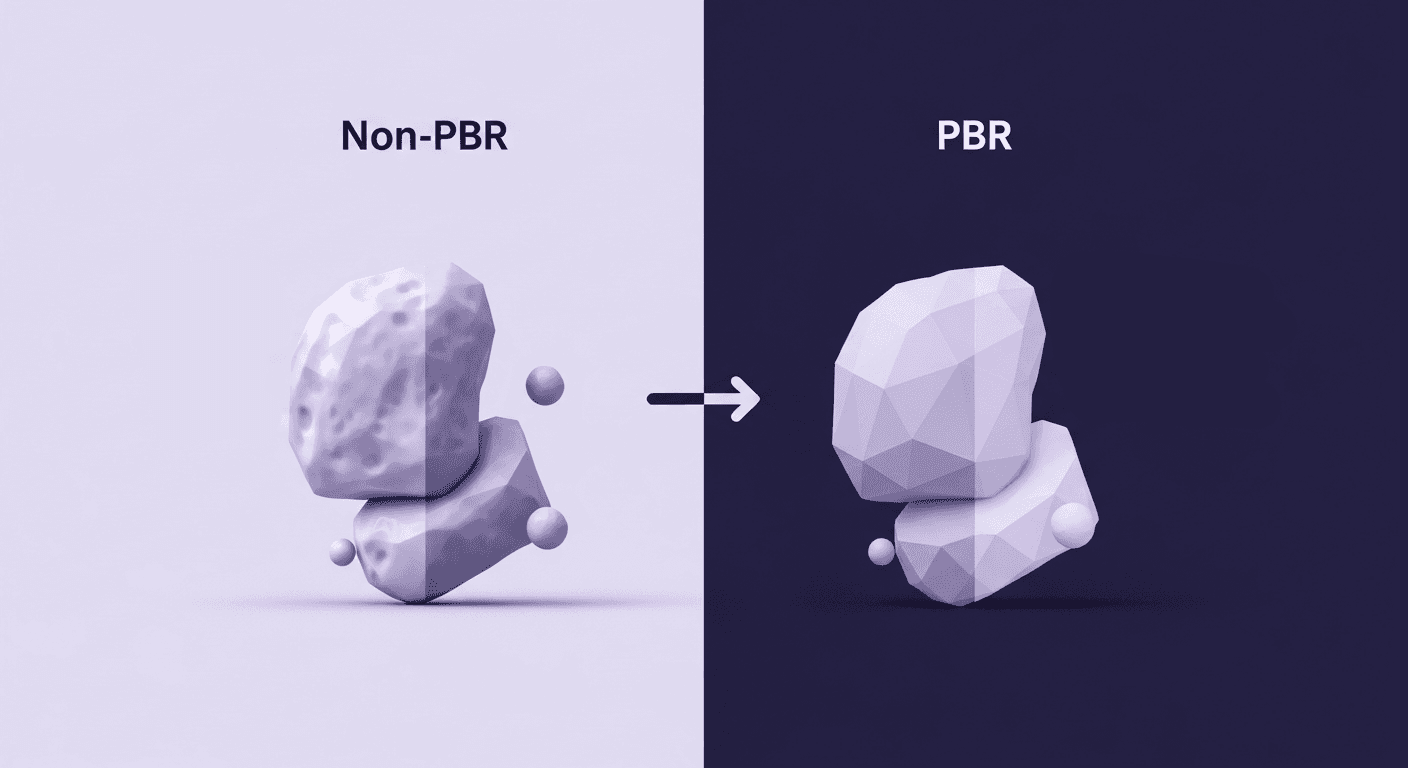
Remember spending hours tweaking a specular map to look just right in one corner of a level, only to watch it completely fall apart the moment the lighting changed? We’ve all been there. That’s the core problem Physically Based Rendering (PBR) was built to solve. In this breakdown, we'll unpack the fundamental differences between PBR and traditional materials—not just which maps to use, but the core shift in thinking that makes modern assets so predictable and consistent. It’s about moving from environment-dependent guesswork to a unified system grounded in physics, and getting it right is the key to building a smarter, more efficient pipeline.
The foundation: What are we comparing?
If you've been in the industry for a while, you remember the old days. The time before PBR became the default. You probably spent countless hours tweaking textures to look just right in one specific corner of a level, only to see them fall apart the moment the lighting changed. That was the reality of traditional, non-PBR material mapping.
Defining traditional (Non-PBR) material mapping
The old-school workflow was a masterclass in artistic approximation. It primarily revolved around three key texture maps:
- Diffuse: This was your base color map, but it was often much more. Artists would bake in soft ambient occlusion, subtle light direction, and even tiny specular highlights to fake depth and detail. It was less about the material's actual color and more about how it looked under a specific, idealized light.
- Specular: This map controlled the color and intensity of the shiny highlights. You were essentially painting reflections. A bright white spot on the specular map meant a sharp, intense highlight, while a darker gray meant a more subdued one. It was pure artistic interpretation, with no physical basis.
- Glossiness: Paired with the specular map, this controlled the size of the highlight. A high gloss value created a tight, focused highlight (like polished chrome), while a low value spread it out (like rough plastic).
Artists became incredibly skilled at using this trio to fake realism. It was an art form built on clever tricks and workarounds. But the system had a fundamental flaw: it wasn't simulating light; it was mimicking its effects in a static environment. Move the asset to a different scene, and all that hard work would unravel. This is where a more robust system was needed, one based on physics, not just artistic guesswork.
What exactly are PBR materials? The core concepts
Physically Based Rendering (PBR) isn't just a buzzword; it's a fundamental shift in how we approach materials. The Physically-Based part means we're trying to simulate how light actually interacts with surfaces in the real world. Instead of faking it, we're defining the physical properties of a material and letting a shader calculate the results based on principles of physics. This approach is grounded in the principle of energy conservation, a surface can't reflect more light than it receives.
This leads to two primary workflows you'll see everywhere. They achieve the same goal but organize the data differently:
- Metal/Roughness: This is the most common workflow today, used by engines like Unreal and tools like Substance Painter. It's intuitive. You define whether a surface is a metal or not (a black-and-white choice) and how rough or smooth its microsurface is.
- Specular/Glossiness: This workflow is still used in engines like CryEngine. Here, the specular map defines the reflectance value and color for both metals and non-metals, while the glossiness map works similarly to its non-PBR counterpart.
Regardless of the workflow, PBR materials rely on a new set of key material properties that drive graphics realism. We're no longer just painting color and shininess. We're defining Albedo, Metallic, Roughness, and Ambient Occlusion as separate, distinct physical attributes. This systematic approach is what makes PBR so powerful and predictable.
The head-to-head: Key differences between PBR and traditional texturing
Understanding the theory is one thing, but the real difference becomes clear when you see how these two approaches behave in practice. It's a shift from an environment-dependent process to a physically consistent one, and it changes everything about how artists work.
Predictable vs. Unpredictable: How materials react to light
This is the most critical distinction. A non-PBR asset is a fragile illusion. Imagine creating a beautifully textured wooden shield. In your sunlit showcase scene, the diffuse map with its baked-in shadows and the hand-painted specular highlights look perfect. Now, take that same shield and put it in a dimly lit cave. Suddenly, it looks wrong. The baked-in lighting clashes with the new environment, and the specular highlights feel artificial because they don't respond to the cave's soft, ambient light. The illusion breaks.
Physically Based Rendering (PBR) materials solve this. Because PBR textures define intrinsic physical properties, the base color, its metallic nature, and its surface roughness, they react predictably to any lighting condition. That wooden shield, authored with a PBR workflow, will look correct in direct sunlight, in shadow, under the fluorescent lights of a bunker, or next to a flickering torch. The material just works because the rendering engine is calculating how that specific surface should behave based on the light it receives. This consistency is the cornerstone of modern 3D rendering techniques.
Workflow and authoring: Artist-friendly vs. Environment-dependent
The workflow implications are massive. With the traditional approach, artists were constantly on the defensive, tweaking textures for every possible lighting scenario. An asset wasn't done until it was approved in its final environment, leading to endless back-and-forth and iteration cycles.
The PBR advantage is simple and profound: create once, use everywhere. An artist can author a material in a tool like Substance Painter or Quixel Mixer under neutral lighting and have full confidence it will look correct when dropped into any scene in the game engine. This decouples the art creation process from the level design and lighting process, allowing teams to work in parallel far more effectively. It turns texturing from a reactive task into a proactive one.
A deeper look at the maps: How PBR and non-PBR differ
The texture maps themselves reflect this philosophical change. It's not just about renaming conventions; it's about a complete redefinition of what each map is responsible for.
- From diffuse to albedo: A traditional Diffuse map was a mix of color and subtle lighting information (like ambient occlusion). An Albedo map, by contrast, is pure color. It represents the base color of a material as if it were viewed under pure white, directionless light, completely free of shadows or highlights. This purity is essential for the lighting system to do its job correctly.
- From specular/gloss to metallic/roughness: This represents the biggest mental leap. The old Specular/Gloss workflow was about painting reflections. The new Metallic/Roughness workflow is about defining the physical nature of the surface itself. This is a core evolution in surface shading techniques. The Metallic map is typically a black-and-white texture: white means the material is a metal, and black means it's a non-metal (or dielectric). The Roughness map defines the microsurface structure; a low roughness value (black) means a smooth, mirror-like surface, while a high value (white) means a rough, matte surface that diffuses light widely.
This shift moves the artist from being a painter of light to a definer of matter. It’s a more powerful, intuitive, and scalable way to think about creating assets.
The practical impact: Why PBR matters for your pipeline
Adopting PBR is more than an aesthetic upgrade; it’s a strategic decision that strengthens your entire art pipeline. The benefits extend beyond just making things look more realistic; they create efficiency, consistency, and a more streamlined workflow from start to finish.
The benefits of PBR in game development and simulation
So, how does PBR improve visual realism in 3D graphics in a way that actually helps production? It comes down to two key areas:
- A unified visual standard: PBR provides a common language for materials. When every asset, from characters and weapons to environments and props, is built using the same physically-based principles, you achieve a level of visual cohesion that was nearly impossible with traditional methods. A piece of steel will reflect light like steel, whether it's on a hero character's armor or a background pipe. This consistency is what makes a world feel believable and immersive, not just a collection of disconnected art assets.
- A streamlined art pipeline: The "author once, use everywhere" nature of PBR is a massive win for production speed. Artists can build libraries of validated materials (e.g., oak wood, brushed aluminum, concrete) that can be reused across projects with confidence. This dramatically reduces the time spent on redundant texturing tasks and minimizes the painful cycle of tweaking assets for different environments. It allows your team to iterate faster, focusing their creative energy on building new assets rather than fixing old ones.
How to implement a physically based rendering workflow
Transitioning to or refining a PBR workflow requires a holistic view of your pipeline. Here are the key considerations:
- Engine & tools: Most modern game engines (Unreal Engine, Unity, Godot) are built from the ground up for PBR. The real focus is on your authoring tools. Software like Adobe Substance 3D Painter and Quixel Mixer are the industry standard because they provide a dedicated environment for creating and validating PBR materials.
- Team training: The biggest hurdle is often the conceptual shift. Artists need to unlearn old habits like baking lighting into diffuse maps and learn to think in terms of physical properties. Providing clear guidelines, reference materials, and training sessions is crucial for a smooth transition.
- A note on converting traditional textures: You might be wondering, can you convert traditional textures to a PBR workflow? The short answer is: not really, or at least not without significant rework. An old diffuse map has lighting and specular information baked in, making it impossible to cleanly extract a pure Albedo map. Similarly, you can't magically generate accurate Metallic and Roughness data from a legacy Specular map. The most effective approach is to re-author legacy assets using the original source art, treating the old textures as a reference rather than a starting point.
The big picture: Standardizing for the future
Choosing PBR isn’t just about the immediate benefits to a single project. It’s about aligning your team with the universal standard for real-time graphics and building a pipeline that is efficient, scalable, and future-proof.
How PBR unifies 3D rendering techniques across industries
PBR is not just a trend in video games. It has become the standard rendering methodology in film and VFX, architectural visualization, automotive design, and real-time product simulations. This cross-industry adoption is significant. It means there's a shared language and methodology for describing materials, making assets more portable and talent more adaptable. An artist skilled in PBR can move between these industries more fluidly than ever before.
This universal standard ensures that the skills your team develops are relevant and forward-looking. By standardizing on PBR, you’re not just adopting a workflow; you're plugging into a global ecosystem of tools, resources, and talent, which goes far beyond a single domain like flight simulation or game development.
Moving beyond "It just looks better" to pipeline efficiency and scalability
Ultimately, the most compelling argument for PBR in a production environment isn't just that it produces more realistic images. The true value lies in the pipeline efficiency and scalability it enables.
PBR replaces artistic guesswork with a predictable, rules-based system. This predictability removes countless hours of manual adjustments and subjective feedback loops. It establishes a clear, objective baseline for material quality, which allows artists to work more autonomously and consistently. For a technical artist, this is the ultimate prize: a pipeline that is easier to manage, scale, and troubleshoot, freeing up your most valuable resource, your team's creative time to build better worlds.
Beyond better pixels: Building a smarter foundation
So, what’s the real takeaway? The leap from traditional rendering to PBR was never just about swapping a Specular map for a Roughness map. It was about trading artistic guesswork for physical ground truth, and that shift changes everything.
For you, as an artist, this is where the true value clicks into place. It’s not just about achieving photorealism; it’s about building a predictable, scalable pipeline. It means an artist can build a material with confidence, knowing it will hold up under any lighting, in any environment. It gives your team a shared language for how surfaces should behave, cutting down on subjective feedback and endless tweaking.
Ultimately, standardizing on PBR is about reclaiming your team’s most valuable resource: their creative energy. You’re not just adopting a rendering workflow; you’re building a foundation that lets your artists spend less time fighting broken assets and more time bringing worlds to life. That’s a pipeline worth investing in.

Max Calder
Max Calder is a creative technologist at Texturly. He specializes in material workflows, lighting, and rendering, but what drives him is enhancing creative workflows using technology. Whether he's writing about shader logic or exploring the art behind great textures, Max brings a thoughtful, hands-on perspective shaped by years in the industry. His favorite kind of learning? Collaborative, curious, and always rooted in real-world projects.
Latest Blogs
The Indie Dev Guide to CC0 PBR Textures: Stop Searching, Start Cr...
PBR textures
AI in 3D design

Mira Kapoor
Jul 10, 2026
Sourcing Free Game Textures: Navigating PBR Pipelines and Stylize...
PBR textures
Game textures
Mira Kapoor
Jul 6, 2026
Sculpting with Sunlight: The Architectural Physics of Facade Text...
Texture creation
AI in 3D design

Max Calder
Jul 1, 2026

Accelerate you workflow
with automated PBR texture generation
Enjoy creative freedom with AI powered texture creation
 Texturly
Copyright © 2026 Texturly, Asha Technology Labs Pvt. Ltd. All rights reserved