How AI Minecraft Texture Generators Are Changing Resource Pack Creation
By Max Calder | 10 June 2026 | 8 mins read
Table of contents
Table of Contents
Minecraft has always been a game fueled by pure imagination. While its classic blocky world is famous worldwide, a huge part of the game’s charm comes from its community. Over the years, players have created thousands of custom texture packs (also called resource packs). These packs change everything from the look of a simple dirt block to the terrifying appearance of the Ender Dragon, allowing players to completely redesign their gaming experience.
However, making an entire texture pack from scratch is an incredibly slow and difficult task. It takes weeks of manual pixel art, a deep understanding of color matching, and endless patience. For many creative players, the technical barrier is just too high.
That is where artificial intelligence (AI) steps in. AI-powered texture tools are completely changing the landscape of Minecraft design. By making texture creation faster, easier, and accessible to everyone, AI is helping creators bring their dream worlds into the game in record time. Let's dive into the core advantages of using AI for Minecraft texture generation.
The big problem: Why traditional texture design is slow
To appreciate how much AI helps, we first need to look at how hard it is to make a traditional Minecraft resource pack.
The pain of pixel-by-pixel art
Minecraft textures are usually small pixel-art squares, like 16 x 16 or 32 x 32 pixels. Because the canvas is so tiny, every single dot counts. If an artist places just one pixel in the wrong spot or uses a shade of green that is slightly too bright, the entire block can look strange and distracting when placed in the game world. Artists have to spend hours zooming in, clicking pixel by pixel, and manually painting shadows and highlights.
The struggle of keeping hundreds of blocks consistent
A complete Minecraft pack doesn't just change one block; it changes hundreds of them. You have to design stone, cobblestone, mossy cobblestone, cracked stone bricks, and smooth stone. All of these separate blocks need to look like they belong to the exact same universe. If your wood planks look like a cartoon but your stone looks hyper-realistic, the game will look messy and unpolished. Keeping that visual consistency across a massive asset library is exhausting for a single person.
Giving players superpowers: How AI changes the pipeline
An AI Minecraft texture generator acts like a super-fast design assistant, taking over the boring parts of the job so you can focus on building your world.
Turning words into blocks instantly
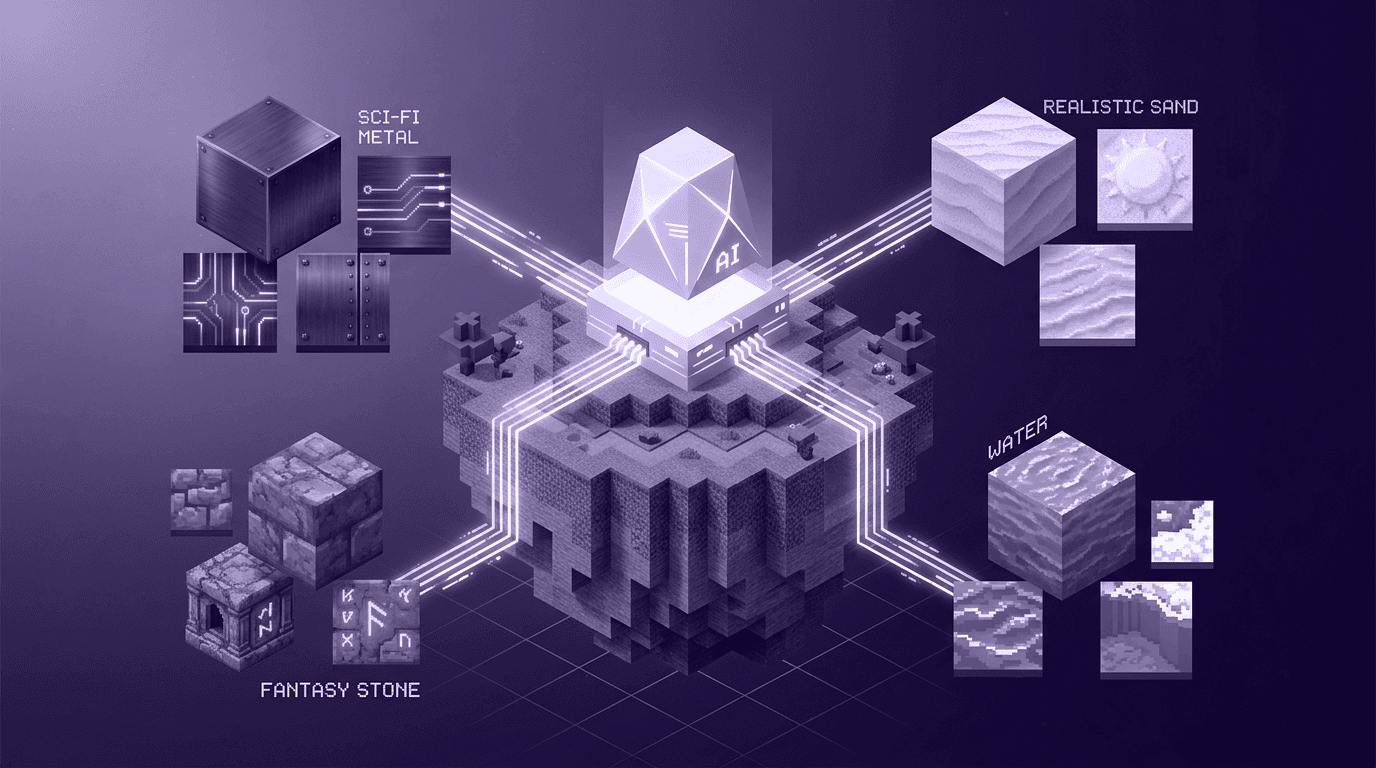
Imagine you are building a custom adventure map set in a haunted kingdom. You need a very specific look for your blocks, like "dark, cracked castle stone covered in glowing purple runes."
Instead of opening a paint program and trying to figure out how to draw that pixel by pixel, you simply type that description into an AI tool. Within seconds, the AI generates multiple high-quality options. You can pick the best one and load it right into your resource pack. It turns hours of manual labor into a quick, fun brainstorming session.
Testing and tweaking in record time
Textures always look different inside the actual game than they do in a paint program. You have to see how they look under the midday sun, inside a dark cave, or when placed next to water.
In a traditional workflow, if a texture looks bad in-game, you have to close Minecraft, open your editing software, make manual fixes, and reload the game. With AI, you can generate variations instantly. If your stone looks too dark, you can ask the AI to "make it twenty percent brighter" or "add more moss texture," creating a fast, seamless editing loop.
Key Takeaway: AI lowers the entry barrier. You no longer need to be a professional pixel artist to bring a custom texture pack idea to life.
Unlocking new worlds: Massive visual diversity
Because AI makes it so easy to experiment, it is pushing Minecraft’s visual boundaries far beyond the usual styles we see every day.
From dark fantasy to epic sci-fi
Most community texture packs fall into common themes like medieval or cartoon styles. Creating something completely unique, like an alien world or a cyberpunk city, takes a lot of trial and error. AI excels at exploring imaginative concepts. You can blend abstract ideas together, like mixing "ancient Egyptian patterns" with "futuristic neon circuitry," allowing creators to build entirely new genres of Minecraft worlds that no one has ever seen before.
Making hyper-realism easy
High-resolution texture packs (512 x 512 pixels or higher) can turn Minecraft into a breathtaking, photorealistic experience. However, drawing high-resolution textures by hand is almost impossible for a solo creator. AI tools can analyze real-world photos of wood, brick, or metal, clean up the lighting, and scale them down perfectly so they tile seamlessly across Minecraft's blocky terrain without any ugly seams or glitches.
A game-changer for modders, map makers, and server owners
AI texture generation isn’t just great for casual players; it is a massive superpower for developers and community leaders.
Faster mod art for developers
Minecraft modders are usually brilliant programmers, but they aren't always great artists. Many amazing mods, like ones that add complex machinery, new dimensions, or custom magical items, are delayed because the developer is struggling to create the visual art for those items. AI helps bridge this gap. A programmer can quickly generate clean, theme-accurate textures for their new items and blocks, keeping their development momentum moving fast.
Custom textures for story-driven Maps
The best adventure maps use custom items to tell a story. A custom RPG map might feature unique weapons, special keys, or ancient artifacts. Creating these unique item textures by hand for a single map takes a massive amount of time away from building the actual levels. AI allows map makers to generate themed asset collections in days instead of months, letting them focus their energy on storytelling, building, and fun gameplay mechanics.
The human touch: Why AI won't replace true creativity
A lot of players worry that using AI means losing the classic soul of Minecraft. However, the most successful projects show that AI works best as a partner, not a replacement.
The challenge of keeping the "Minecraft feel."
AI models are trained on millions of images, which means they love adding smooth gradients, high-tech details, and realistic shadows. But Minecraft relies on a very specific, simplified aesthetic. If a texture has too much detail, it creates visual noise that makes the game hurt your eyes to look at. Human creators are essential because they must guide the AI, filter out the messy designs, and ensure the final blocks still feel like they belong in a block-based sandbox.
The artist as the ultimate director
An AI can give you fifty different options for a brick wall, but it cannot understand the emotion or mood of your game map. It doesn't know if a room should feel cozy or terrifying. The human creator is still the director. You choose the colors, set the tone, assemble the files, and make the final artistic decisions. AI simply handles the heavy clicking so you can focus on the big picture.
Ultimate partner for Minecraft creators
At the end of the day, AI texture generation is a massive win for the entire Minecraft community. By taking away the tedious, pixel-by-pixel grind, it opens up the world of 3D design to players who thought they lacked the artistic talent to participate. It allows independent map makers and modders to build massive, polished projects that used to require huge teams.
AI does not replace human imagination; it sets it free. As these tools continue to grow and improve, the gap between having a cool idea and seeing it running inside your Minecraft world is smaller than ever before. Whether you are a server owner looking to brand your community, a developer coding a new mod, or a casual player who wants a personalized survival world, AI texture tools are the ultimate upgrade for your creative toolkit.

Max Calder
Max Calder is a creative technologist at Texturly. He specializes in material workflows, lighting, and rendering, but what drives him is enhancing creative workflows using technology. Whether he's writing about shader logic or exploring the art behind great textures, Max brings a thoughtful, hands-on perspective shaped by years in the industry. His favorite kind of learning? Collaborative, curious, and always rooted in real-world projects.
Latest Blogs
The Indie Dev Guide to CC0 PBR Textures: Stop Searching, Start Cr...
PBR textures
AI in 3D design

Mira Kapoor
Jul 10, 2026
Sourcing Free Game Textures: Navigating PBR Pipelines and Stylize...
PBR textures
Game textures
Mira Kapoor
Jul 6, 2026
Sculpting with Sunlight: The Architectural Physics of Facade Text...
Texture creation
AI in 3D design

Max Calder
Jul 1, 2026

Accelerate you workflow
with automated PBR texture generation
Enjoy creative freedom with AI powered texture creation
 Texturly
Copyright © 2026 Texturly, Asha Technology Labs Pvt. Ltd. All rights reserved