How Texture Quality Impacts User Experience in the Metaverse
By Max Calder | 22 April 2026 | 13 mins read
Table of contents
Table of Contents
The concept of the metaverse has rapidly evolved from a speculative idea into a tangible digital frontier where users interact, socialize, and experience immersive environments in real time. As platforms powered by engines like Unity and Unreal continue to push technological boundaries, the expectations for visual fidelity have risen significantly. Users no longer accept flat, artificial-looking worlds; they expect environments that feel rich, responsive, and convincingly real.
At the core of this realism lies a critical yet often underestimated component: texture quality. While geometry defines the structure of a virtual world, textures bring it to life by adding depth, detail, and material authenticity. From the subtle roughness of a concrete wall to the intricate fibers of fabric, textures directly influence how users perceive and emotionally connect with digital spaces. Poor texture quality can instantly break immersion, while high-quality textures can elevate even simple scenes into compelling experiences.
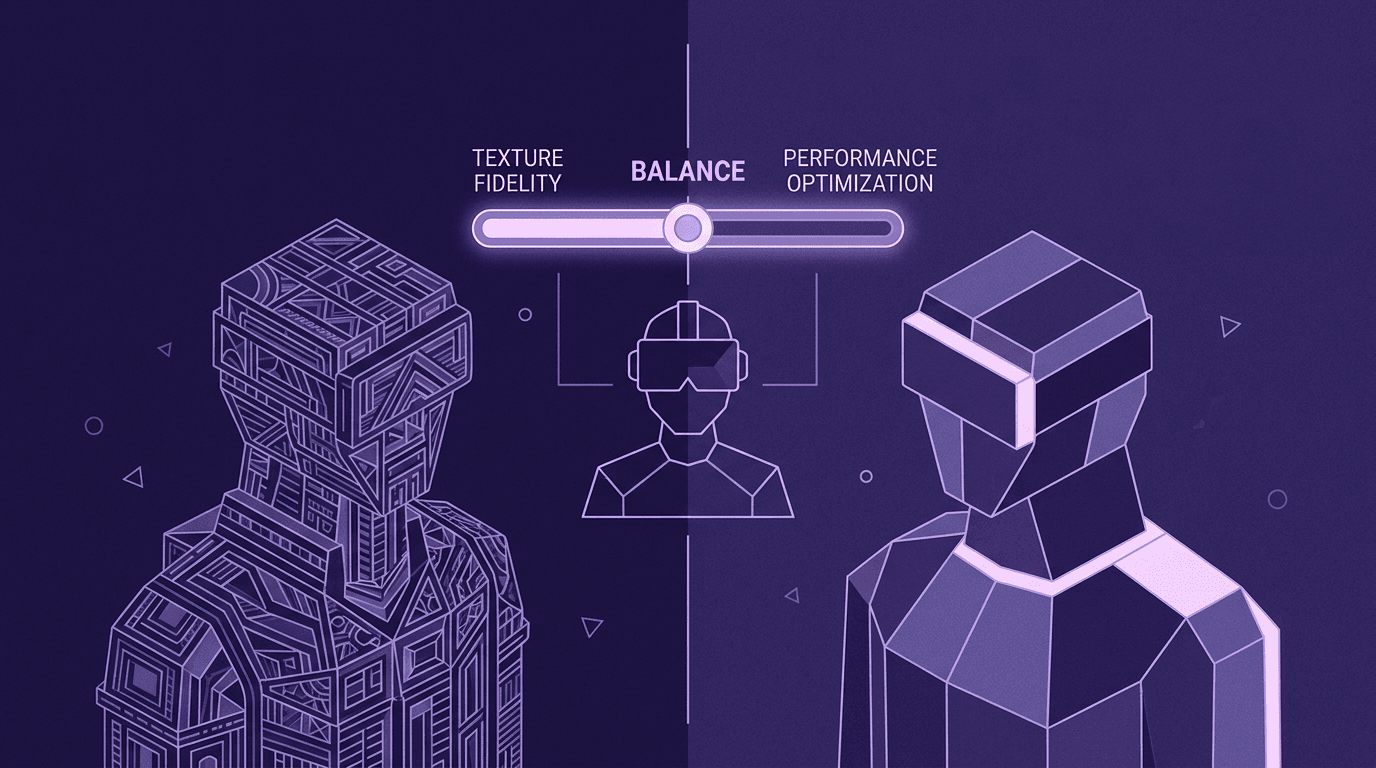
This article explores how texture quality shapes user experience in the metaverse, not just visually but psychologically and emotionally. It breaks down the technical foundations of texture quality, examines its role in immersion and performance, and provides strategic insights for creators aiming to build more engaging and effective virtual environments.
Understanding texture quality in the metaverse
What defines texture quality?
Texture quality is not a single variable; it’s a combination of multiple attributes that collectively determine how realistic and effective a surface appears in a virtual environment. The most obvious factor is resolution, typically measured in 2K, 4K, 6K, or even 8K textures. Higher resolution allows for greater pixel density, which translates into sharper details, especially during close-up interactions common in VR experiences.
However, resolution alone is not sufficient. Detail density plays an equally critical role; this refers to how much meaningful visual information is embedded within the texture. A 4K texture with poor detailing can still appear flat, while a well-crafted 2K texture with strong surface variation can feel more convincing. Seamlessness is another defining factor, particularly for tiling textures used across large surfaces. Visible repetition or seams can quickly break immersion, making proper tiling techniques essential.
Types of textures used in virtual environments
Modern metaverse environments rely heavily on Physically Based Rendering (PBR) workflows, which use multiple texture maps to simulate real-world material behavior under lighting. The most common maps include:
- Albedo (Diffuse) maps: Define the base color of a surface without lighting information
- Normal maps: Simulate surface detail without adding geometry, enhancing depth perception
- Roughness maps: Control how light scatters across a surface (matte vs glossy)
- Metallic maps: Define whether a surface behaves like a metal or a non-metal
- Ambient Occlusion maps: Add subtle shadowing in crevices for realism
Together, these maps create a layered representation of materials, allowing environments to react dynamically to lighting conditions, an essential requirement for immersive metaverse experiences.
Texture quality vs. Performance trade-offs
While high-resolution textures significantly improve visual fidelity, they come at a cost. Larger textures consume more GPU memory, increase bandwidth usage, and can negatively impact frame rates, especially in real-time environments like VR, where performance stability is critical.
This creates a constant balancing act for creators. On one hand, high-quality textures enhance immersion; on the other, excessive texture sizes can lead to lag, stuttering, or longer load times. Techniques like texture compression, mipmapping, and Level of Detail (LOD) systems are often used to mitigate these issues. The goal is not to maximize texture resolution indiscriminately, but to optimize it strategically based on user interaction, viewing distance, and platform constraints.
Understanding this balance is fundamental for any creative director or technical artist aiming to deliver both visually compelling and performance-efficient metaverse experiences.
How texture quality shapes visual realism
Enhancing environmental detail and depth
Texture quality is the primary driver of perceived detail in any metaverse environment. While geometry defines form, it is texture that communicates material identity, whether a surface feels like worn leather, polished metal, or rough concrete. High-quality textures introduce micro-details such as scratches, pores, grain patterns, and imperfections that mimic real-world surfaces. These subtle cues are what the human eye relies on to interpret realism.
In large-scale environments, this becomes even more critical. Without sufficient texture detail, expansive scenes can appear flat and artificial, regardless of how complex the geometry is. By contrast, well-crafted textures add layers of visual richness, creating depth without increasing polygon count, an efficient way to enhance realism while maintaining performance budgets.
The role of high-resolution textures in immersion
In immersive environments, particularly VR, users frequently interact with objects at close range. This is where texture resolution becomes highly noticeable. Low-resolution textures can appear blurry or pixelated when viewed up close, immediately breaking the illusion of reality. High-resolution textures, on the other hand, maintain clarity and sharpness, preserving immersion even during detailed inspection.
This is especially important in interactive scenarios such as virtual shopping, training simulations, or social spaces, where users naturally focus on objects, avatars, and environments at varying distances. Consistent texture clarity ensures that the experience feels continuous and believable, rather than fragmented by visual inconsistencies.
Consistency across assets
One of the most overlooked aspects of texture quality is consistency. Even if individual assets are high quality, a mismatch in texture resolution or detail across different objects can disrupt the overall visual coherence of a scene. For example, a hyper-detailed surface placed next to a low-resolution asset creates a noticeable contrast that undermines realism.
Maintaining consistent texel density (texture resolution relative to object size) across assets is essential in metaverse environments, where users can freely explore and compare elements within a scene. A cohesive texture strategy ensures that all components, whether foreground or background, contribute to a unified visual experience.
For creative directors and technical teams, this means establishing clear standards for texture resolution, detail levels, and material workflows early in the production pipeline. When executed correctly, texture consistency reinforces immersion, making the virtual world feel intentional, polished, and believable.
Psychological and emotional impact on users
Perceived realism and presence
Texture quality does more than enhance visuals; it directly influences a user’s sense of presence within the metaverse. Presence is the psychological state where users feel as though they are inside the virtual environment rather than observing it from the outside. High-fidelity textures contribute to this by aligning visual cues with real-world expectations, reducing the cognitive gap between reality and simulation.
When surfaces behave and appear as expected, wood looks fibrous, metal reflects light accurately, fabric shows softness, and users subconsciously accept the environment as believable. Conversely, low-quality or inconsistent textures create friction in perception, constantly reminding users that they are in a simulated space. This subtle disruption can significantly weaken immersion, even if other elements like lighting or animation are well-executed.
Emotional engagement through visual quality
Beyond realism, texture quality plays a key role in shaping emotional responses. Environments with rich, detailed textures can evoke specific moods, warmth, tension, comfort, or unease, depending on how materials are represented. For example, soft, worn textures can create a sense of familiarity and nostalgia, while sharp, clean surfaces may evoke modernity or sterility.
In storytelling-driven metaverse experiences, this becomes a powerful tool. Texture choices can reinforce narrative themes without explicit cues, guiding users’ emotional journeys through visual design alone. Poor texture quality, on the other hand, can flatten emotional impact, making environments feel generic or uninspired.
User trust and experience quality
Texture quality also influences how users perceive the credibility and professionalism of a virtual experience. In branded metaverse environments, such as virtual stores, events, or product showcases, low-quality textures can signal a lack of attention to detail, reducing user trust and engagement.
High-quality textures, by contrast, communicate polish and intentionality. They suggest that the creators have invested in delivering a premium experience, which can positively impact user retention and brand perception. This is particularly important in commercial metaverse applications, where visual quality directly affects user behavior, from exploration time to purchase decisions.
Understanding this psychological layer is critical. Texture quality is not just a technical or aesthetic decision; it is a strategic lever that shapes how users feel, engage, and ultimately respond to a virtual experience.
Texture quality and performance in real-time metaverse platforms
Optimization techniques for high-quality textures
Delivering high-quality textures in real-time environments requires careful optimization. Raw high-resolution assets, especially 4K, 6K, or higher, can quickly overwhelm GPU memory if not managed properly. To address this, developers rely on several industry-standard techniques.
Texture compression is one of the most widely used methods, reducing file size while preserving visual fidelity as much as possible. Formats like BCn (DXT) or ASTC allow efficient storage and faster rendering. Mipmapping is another essential technique, where multiple scaled-down versions of a texture are generated and dynamically selected based on viewing distance. This reduces aliasing and improves performance without sacrificing perceived quality.
Level of Detail (LOD) systems extend this concept further by adjusting not just textures but entire assets based on distance from the camera. Combined, these techniques ensure that high-quality textures are used where they matter most, close to the user, while lighter versions handle distant elements.
Balancing fidelity with frame rate
In metaverse platforms, especially those experienced through VR, maintaining a stable frame rate is non-negotiable. Even minor drops in performance can lead to discomfort, motion sickness, or disengagement. This makes texture optimization a critical part of performance budgeting.
High-resolution textures increase memory bandwidth usage and can slow down rendering pipelines if overused. The key is prioritization, allocating higher texture resolution to focal points or interactive elements, while reducing detail in peripheral or less noticeable areas. This selective fidelity approach ensures that users perceive high quality where it matters most, without overloading the system.
Platform constraints (VR, Web, Mobile)
Not all metaverse experiences are built for the same hardware, and texture strategies must adapt accordingly. High-end VR systems and gaming PCs can handle larger textures and more complex materials, while web-based or mobile platforms operate under tighter constraints.
In VR, texture clarity is particularly important due to proximity and stereoscopic viewing, but so is performance stability. This often leads to hybrid strategies, using high-resolution textures selectively while aggressively optimizing background assets. On mobile devices, where memory and processing power are limited, developers may rely more on efficient tiling textures, atlases, and procedural techniques to maintain acceptable quality.
Understanding these platform-specific limitations allows teams to design scalable texture pipelines. Instead of a one-size-fits-all approach, assets are tailored to deliver the best possible user experience within each platform’s constraints, ensuring accessibility without sacrificing core immersion.
Best practices for creating high-impact textures
Choosing the right resolution strategy
One of the most common mistakes in metaverse production is defaulting to the highest possible texture resolution without considering context. An effective texture strategy is about precision, not excess. High-resolution textures (4K–6K) should be reserved for hero assets and interactive elements, objects that users engage with closely or that serve as focal points within a scene.
For mid-ground and background assets, lower resolutions (1K–2K) are often sufficient, especially when combined with strong material definition. This tiered approach not only optimizes performance but also ensures efficient memory allocation across the environment. Establishing resolution guidelines early in the pipeline helps maintain consistency and prevents unnecessary rework later.
Leveraging PBR workflows effectively
Physically Based Rendering (PBR) has become the standard for achieving realism in modern engines like Unity and Unreal. However, simply using PBR maps is not enough; their quality and calibration determine the final outcome.
Accurate roughness and metallic values are essential for believable light interaction. Overly glossy or incorrectly calibrated materials can feel artificial, even if the texture resolution is high. Consistency in material response across assets is equally important to maintain visual coherence. Teams should rely on calibrated reference materials and real-world scanning where possible to ensure physically accurate results.
Procedural vs. Handcrafted textures
Both procedural and handcrafted approaches have their place in metaverse production, and the most effective pipelines often combine the two. Procedural textures, created using tools like Substance Designer, offer scalability and flexibility. They allow rapid iteration, easy adjustments, and seamless tiling, making them ideal for large environments.
Handcrafted textures, on the other hand, provide artistic control and uniqueness. They are particularly valuable for hero assets or stylized experiences where specific visual storytelling is required. The key is to use procedural methods for efficiency and consistency, while reserving handcrafted detailing for elements that demand a higher level of artistic nuance.
Maintaining consistency across large-scale worlds
In expansive metaverse environments, consistency becomes a major challenge. Without a unified approach, assets created by different artists or teams can vary in texel density, material response, and overall quality. This inconsistency can break immersion even if individual assets are well-made.
To avoid this, studios should implement standardized asset libraries, shared material presets, and clear documentation for texture creation. Regular reviews and validation processes help ensure that all assets align with the defined visual benchmarks. A well-structured pipeline not only improves quality but also accelerates production by reducing ambiguity and rework.
These practices are essential for balancing artistic vision with technical constraints, ensuring that every texture contributes meaningfully to the overall user experience.
Future trends: Texture quality in the evolving metaverse
AI-generated and upscaled textures
AI is rapidly transforming how textures are created and optimized. Advanced models can now generate high-quality, tileable textures from simple prompts or low-resolution inputs, significantly reducing manual workload. AI-driven upscaling tools are also enabling creators to convert 1K or 2K textures into higher resolutions like 4K or 6K while preserving detail and minimizing artifacts.
For studios, this means faster iteration cycles and the ability to scale content production without proportionally increasing resources. Creative directors can leverage AI not just for efficiency, but also for experimentation, quickly exploring multiple visual directions before committing to a final style.
Real-time streaming of high-resolution assets
As metaverse platforms evolve, real-time streaming of high-resolution textures is becoming more viable. Instead of loading all assets locally, cloud-based systems can stream textures dynamically based on user interaction and viewpoint. This approach reduces device-level constraints, allowing even lower-end hardware to display high-fidelity environments.
This shift introduces new possibilities for maintaining ultra-high visual quality without compromising performance. However, it also requires robust infrastructure and careful management of latency to ensure seamless user experiences.
Increasing demand for hyper-realism
User expectations are continuously rising, driven by advancements in gaming, film, and real-time rendering technologies. The demand for hyper-realistic environments in the metaverse is pushing texture quality standards higher than ever. This includes not just higher resolutions, but also more accurate material representation, dynamic wear and tear, and context-aware detailing.
At the same time, stylized experiences are also evolving, with texture quality playing a key role in defining unique visual identities. Whether aiming for realism or stylization, the emphasis is on intentional, high-quality execution rather than compromise.
For forward-thinking teams, staying ahead means investing in scalable pipelines, adopting emerging tools, and continuously refining texture strategies to meet these growing expectations.
Elevating metaverse experiences through strategic texture quality
Texture quality is a foundational element that shapes how users perceive, feel, and interact within the metaverse. It goes beyond visual enhancement, impacting immersion, emotional engagement, and even user trust. From defining material realism to influencing performance and platform scalability, textures play a critical role in every layer of the user experience.
For creative directors and technical teams, the challenge lies in balancing fidelity with efficiency. High-resolution textures must be applied strategically, supported by optimized workflows and consistent standards across assets. When executed effectively, texture quality becomes a powerful tool for delivering immersive, high-impact environments that resonate with users.
As the metaverse continues to evolve, the importance of texture quality will only grow. Those who invest in the right techniques, tools, and creative strategies today will be better positioned to build compelling, future-ready experiences that stand out in an increasingly competitive digital landscape.

Max Calder
Max Calder is a creative technologist at Texturly. He specializes in material workflows, lighting, and rendering, but what drives him is enhancing creative workflows using technology. Whether he's writing about shader logic or exploring the art behind great textures, Max brings a thoughtful, hands-on perspective shaped by years in the industry. His favorite kind of learning? Collaborative, curious, and always rooted in real-world projects.
Latest Blogs

The Indie Dev Guide to CC0 PBR Textures: Stop Searching, Start Cr...
PBR textures
AI in 3D design

Mira Kapoor
Jul 10, 2026
Sourcing Free Game Textures: Navigating PBR Pipelines and Stylize...
PBR textures
Game textures
Mira Kapoor
Jul 6, 2026

Sculpting with Sunlight: The Architectural Physics of Facade Text...
Texture creation
AI in 3D design

Max Calder
Jul 1, 2026

Accelerate you workflow
with automated PBR texture generation
Enjoy creative freedom with AI powered texture creation
 Texturly
Copyright © 2026 Texturly, Asha Technology Labs Pvt. Ltd. All rights reserved