From Creator to Curator: How AI Pattern Generators Redefine Design Roles
By Mira Kapoor | 14 January 2026 | 7 mins read
Table of contents
Table of Contents
The path from a brilliant concept to a final textile print can be a grind. It’s a cycle of endless revisions, slow turnarounds, and samples that don’t quite capture the initial spark. This is where AI pattern generators are changing the game. Think of them not as a replacement for designers, but as a powerful new creative engine. In this article, we’ll unpack what these tools are, how they plug into a modern 3D workflow, and what they really mean for the future of your team’s creativity. By automating the repetitive parts of pattern creation, this technology frees designers to focus less on manual execution and more on what truly matters: high-level creative direction and telling a compelling story.
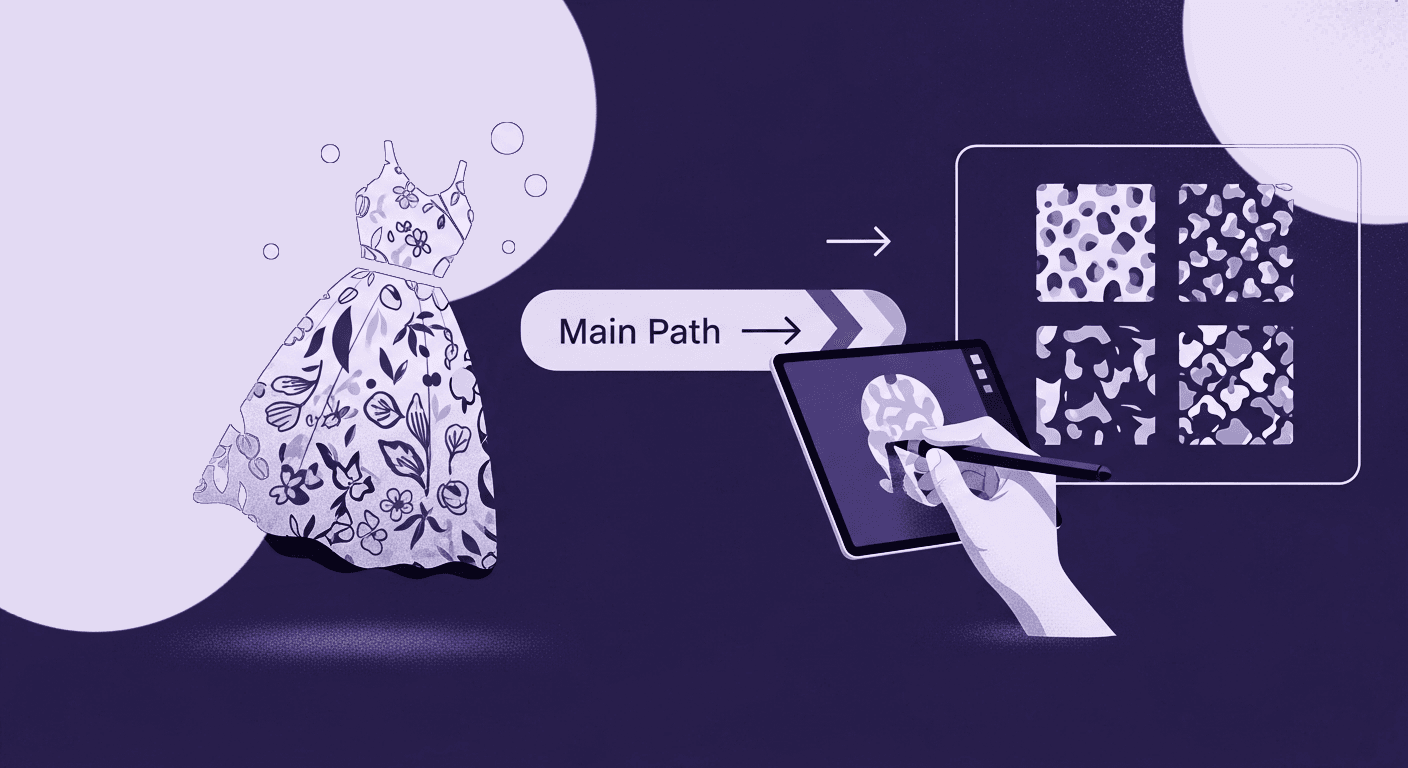
The new foundation: What exactly are AI pattern generators?
At its core, an AI pattern generator is a specialized form of generative AI, akin to systems like Midjourney or DALL-E, but meticulously trained for textile and surface design. It’s not just another filter or plugin; it’s a collaborative partner that translates creative language into visual reality.
From text prompt to textile: The core mechanics
The process begins with a simple text prompt. For instance, a designer might type: a seamless Art Deco pattern with geometric fans and stylized lotus flowers in a palette of gold, cream, and deep teal. The AI dissects this prompt into key concepts: style (Art Deco), motifs (fans, lotus flowers), color palette, and technical constraints (seamless). It then generates a unique image by synthesizing these elements from its vast training data. This isn't a search for a pre-existing pattern; it's the creation of something new from a learned understanding of visual concepts. The workflow shifts from manual drawing to creative direction.
More than just repeats: The leap in generative design
Traditional digital tools like Adobe Illustrator are deterministic: your output is a direct result of your manual input. AI introduces an element of controlled serendipity. You set the creative boundaries with your prompt, and the AI explores the possibilities within them, often producing unexpected and delightful variations. Think of a traditional tool as a stencil, creating perfect copies. An AI generator is more like a kaleidoscope; you provide the core elements, but each turn reveals a new, unique composition. This leap moves the designer from a technician role to that of a creative director.
The efficiency engine: How AI transforms fashion design workflows
One of the most significant barriers in fashion design is the time and cost from concept to sample. AI pattern generators act as a powerful engine to break through this bottleneck, fundamentally altering the pace of creation.
Slashing prototyping time and cost
The traditional cycle of briefing a print designer, waiting for concepts, and iterating through revisions can take days or weeks. With AI, this process can be compressed into a single afternoon. A designer can generate dozens of high-quality pattern options in the time it used to take to create a single rough sketch. This isn't just about saving time; it's about reallocating that time to more creative exploration. When the cost of experimentation is nearly zero, designers are free to take more risks, explore more what-if scenarios, and ultimately arrive at a stronger, more refined design.
Seamless integration with 3D fashion modeling
A new tool is only as good as its ability to fit into an existing pipeline. AI-generated patterns integrate smoothly with modern 3D fashion software. The typical workflow is simple:
1. Generate: Create and refine the seamless pattern tile using the AI tool Texturly.
2. Export: Save the final pattern as a standard image file (e.g., PNG, JPG).
3. Apply: Import the texture into 3D modeling software like Clo3D, Browzwear, or VStitcher, and apply it directly to a digital garment.
This integration allows for instant visualization of how a print drapes, scales, and interacts with the form of a garment, enabling the creation of photorealistic digital samples. This accelerates the design cycle and supports sustainability by reducing the reliance on physical prototypes.
The reality check: Navigating the limitations of AI creativity
While the potential is immense, it's crucial to approach this technology with a healthy dose of realism. Treating AI as a magic button is a recipe for disappointment. Understanding its limitations is the key to leveraging its strengths.
Originality vs. Remix: The nature of AI creation
An AI does not create from a place of consciousness or life experience. It learns by analyzing patterns in vast datasets of existing images. Its output is an incredibly sophisticated remix, a synthesis of what it has seen before. Can it generate a design that is 100% novel, with no precedent in its training data? Probably not. The true originality, therefore, doesn't come from the AI alone. It emerges from the unique prompt crafted by the designer, the careful curation of the generated options, and the human touch in post-processing and application. The AI provides the raw material; the designer provides the vision and the soul.
Practical hurdles: Quality, bias, and integration
Beyond the philosophical debate, there are practical challenges:
- Quality control: AI outputs still require a human eye. Designers must check for technical issues like imperfect seams, strange artifacts, or low resolution. The AI gets you 90% of the way there; a skilled artist handles the crucial final 10%.
- Data bias: AI models are a reflection of their training data. If a dataset is skewed towards Western aesthetics, it will struggle to generate authentic patterns from other cultures. This can lead to a homogenization of styles if not actively countered by designers seeking diverse inspiration and prompting the AI in clever ways.
- Learning curve: Integrating AI requires a new skill: prompt engineering. Learning how to write effective text prompts to get the desired output is an art in itself.
The strategic shift: Redefining the role of the human designer
AI is not replacing fashion designers. It is automating the tedious parts of their job, forcing a strategic evolution of their role. The future of design is less about manual execution and more about high-level creative direction.
From creator to curator
Historically, a designer's value was heavily tied to their technical execution skills. As AI takes over more of the manual pattern creation, the designer's role elevates from creator to curator. Their primary job becomes directing the AI, sifting through numerous possibilities to find the perfect expression of an idea, and ensuring the final result aligns with the brand's story. This places a premium on uniquely human skills: taste, cultural understanding, and narrative storytelling.
AI handles the How, You Master the Why
By automating repetitive tasks, like creating colorways or checking repeats, AI frees up invaluable time and mental energy. This allows design teams to move away from the how of production and focus on the why of the collection. Why this theme? Why this aesthetic for our customer? Why is this story relevant now? The designer of the future is a strategist, a storyteller, and an artist who collaborates with a powerful new tool. The AI is the brush; the designer remains the visionary artist.
Your new creative engine
An AI pattern generator isn't a magic button. As we've seen, it's a sophisticated remixer, not a conscious creator, and it still requires a sharp human eye to guide it. But that was never the point.
Its true power isn't in replacing your team's vision, it's in unleashing it. By automating the tedious hours of iteration and manual repeats it frees your designers to focus on the work that really matters. It allows them to ask bigger questions, explore more what-ifs, and spend their time on narrative and strategy instead of pixels.
Think of it as a new kind of collaborative engine. It handles the technical heavy lifting, so your team can focus on the soul of the collection. You provide the creative direction; it provides the horsepower. You’ve already got the taste and the story. Now you have a tool to back it up.

Mira Kapoor
Mira leads marketing at Texturly, combining creative intuition with data-savvy strategy. With a background in design and a decade of experience shaping stories for creative tech brands, Mira brings the perfect blend of strategy and soul to every campaign. She believes great marketing isn’t about selling—it’s about sparking curiosity and building community.
Latest Blogs
The Indie Dev Guide to CC0 PBR Textures: Stop Searching, Start Cr...
PBR textures
AI in 3D design

Mira Kapoor
Jul 10, 2026
Sourcing Free Game Textures: Navigating PBR Pipelines and Stylize...
PBR textures
Game textures
Mira Kapoor
Jul 6, 2026
Sculpting with Sunlight: The Architectural Physics of Facade Text...
Texture creation
AI in 3D design

Max Calder
Jul 1, 2026

Accelerate you workflow
with automated PBR texture generation
Enjoy creative freedom with AI powered texture creation
 Texturly
Copyright © 2026 Texturly, Asha Technology Labs Pvt. Ltd. All rights reserved