Innovating with Texture in Product Design: A Complete Studio Workflow Guide
By Mira Kapoor | 15 April 2026 | 13 mins read
Table of contents
Table of Contents
For years, texture in product design was treated as a finishing touch, a surface-level decision applied late in the process to enhance aesthetics. Today, that approach is no longer viable. Texture has evolved into a strategic design variable that directly influences usability, manufacturability, and perceived product quality. For industrial design teams, this shift introduces both opportunity and complexity. Texture now impacts how a product is gripped, how it reflects light, how it communicates material quality, and how consistently it can be reproduced at scale. Yet, in many workflows, texture decisions are still made too late, often after form and material choices have already been locked in.
This disconnect creates real operational challenges. Design teams may visualize one outcome, while engineering interprets it differently. Physical prototypes are built, tested, revised, and rebuilt, driving up costs and extending development timelines. What appears to be a minor surface detail often becomes a source of iteration cycles and misalignment.
As product development increasingly relies on digital prototyping and cross-functional collaboration, texture must be treated as part of the core design system, not an afterthought. When integrated early and managed systematically, it becomes a powerful tool for reducing ambiguity, accelerating iteration, and ensuring consistency across teams.
The question is no longer whether texture matters, but how effectively it is integrated into the design and development process.
Rethinking texture: From surface detail to functional design element
How has texture evolved in industrial design?
Texture has undergone a significant shift in industrial design, from being a purely cosmetic layer to becoming a performance-driven design parameter. Traditionally, textures were applied as finishes: matte coatings, brushed metals, or molded patterns intended to enhance visual appeal. These decisions were often made late in the design cycle, with limited impact on the core functionality of the product.
Today, that boundary has dissolved. Texture is now embedded into the design intent from the outset, influencing how products are used, perceived, and manufactured. Advances in materials, manufacturing techniques, and digital tools have made it possible to design textures with precision, enabling them to serve specific functional roles rather than just aesthetic ones.
Why does texture now impact usability and product perception?
Texture directly affects how users interact with a product. Surface patterns can improve grip, reduce slippage, and enhance tactile feedback, critical in categories like consumer electronics, automotive interiors, and wearable devices. A well-designed texture can make a product feel intuitive and comfortable, even before a user consciously evaluates it.
At the same time, texture plays a major role in perceived quality. Subtle variations in surface finish, such as micro-textures or controlled roughness, can signal durability, precision, or premium craftsmanship. These cues are especially important in competitive markets where differentiation is often based on user experience rather than core functionality.
In this context, texture becomes a bridge between engineering performance and user perception, aligning functional requirements with emotional response.
What is the hidden cost of ignoring texture early in the design process?
When texture is treated as an afterthought, it often leads to downstream inefficiencies. Design teams may finalize forms and materials without fully considering how textures will be applied or manufactured. As a result, issues emerge later, unexpected reflections, inconsistent finishes, or incompatibility with production methods.
These problems typically surface during prototyping, triggering revisions that could have been avoided with earlier integration. Each iteration adds cost, delays timelines, and increases the risk of miscommunication between design and engineering teams.
More critically, late-stage texture decisions can create inconsistencies across product lines. Without a standardized approach, textures may vary between components or versions, weakening brand cohesion and user experience.
For experienced design leaders, the takeaway is clear: texture is not just a detail to refine, it is a variable to control. Integrating it early transforms it from a source of friction into a driver of efficiency and innovation.
Inside a product design studio: How leading teams use texture strategically
Integrating texture early in the concept phase
High-performing product design studios no longer treat texture as a downstream decision. Instead, they integrate it directly into the concept development phase, alongside form, material, and function. This approach allows designers to evaluate how surface qualities interact with geometry from the very beginning.
For example, a handheld device isn’t just shaped for ergonomics; it’s textured to enhance grip and tactile feedback. By co-designing material and texture early, teams can make more informed decisions about usability, manufacturing constraints, and visual identity without relying on late-stage adjustments.
This shift reduces ambiguity. Instead of handing off a “finished” design that still requires surface interpretation, teams define texture intent upfront, creating a clearer foundation for downstream development.
Using digital prototypes to validate texture decisions
Digital prototyping has become a critical tool for validating texture decisions before committing to physical production. Advanced rendering and simulation tools allow teams to visualize how textures behave under different lighting conditions, angles, and usage scenarios.
This is particularly valuable for:
- Evaluating surface reflectivity and finish
- Testing perceived material quality
- Identifying inconsistencies across components
Rather than producing multiple physical samples, teams can iterate rapidly in a digital environment, narrowing down viable options before moving to manufacturing. This significantly reduces the number of prototype cycles required.
Aligning design and engineering through shared texture systems
One of the biggest challenges in product development is ensuring that design intent translates accurately into engineering execution. Texture is often a point of misinterpretation; what designers envision as a subtle finish may be implemented differently due to manufacturing constraints or lack of specification.
Leading teams address this by developing shared texture systems, standardized definitions that include parameters such as scale, roughness, pattern density, and application guidelines. These systems act as a common language between design and engineering. When textures are defined as structured assets rather than subjective descriptions, alignment improves. Engineers can implement them with greater precision, and designers can maintain consistency across product lines.
In practice, this approach transforms texture from a vague design element into a controlled, repeatable component of the product development process, reducing miscommunication and ensuring that the final product matches the original vision.
Digital transformation: Scaling texture innovation with modern tools
Why traditional prototyping cycles are inefficient
Physical prototyping has long been the backbone of product validation, but when it comes to texture, it quickly becomes inefficient. Each variation, whether it’s a slight change in roughness, pattern depth, or finish, often requires a new sample. This leads to multiple prototype cycles, increasing both cost and development time.
More importantly, physical prototypes limit exploration. Teams tend to test fewer options because each iteration carries a tangible cost. As a result, potentially better texture solutions are never explored, and decisions are made within a constrained design space.
How digital texture workflows reduce friction
Digital workflows fundamentally change this dynamic. By shifting texture development into a virtual environment, teams can experiment with multiple variations rapidly without incurring production costs.
Designers can:
- Test different surface finishes instantly
- Evaluate texture behavior across various lighting conditions
- Apply textures across multiple product components simultaneously
This enables a more exploration-driven workflow, where decisions are based on comparison and refinement rather than limitation.
Role of seamless textures and PBR materials in product design
For digital workflows to be effective, textures must behave consistently across surfaces and conditions. This is where seamless textures and Physically Based Rendering (PBR) materials become essential.
Seamless textures ensure that patterns repeat without visible edges, maintaining continuity across complex geometries. This is critical for products with curved or multi-part surfaces, where inconsistencies can break visual coherence.
PBR materials, on the other hand, define how textures interact with light. By using maps such as roughness and normal, designers can simulate real-world material behavior with high accuracy. This allows teams to evaluate not just how a texture looks, but how it performs visually in different environments.
AI-driven texture generation and iteration
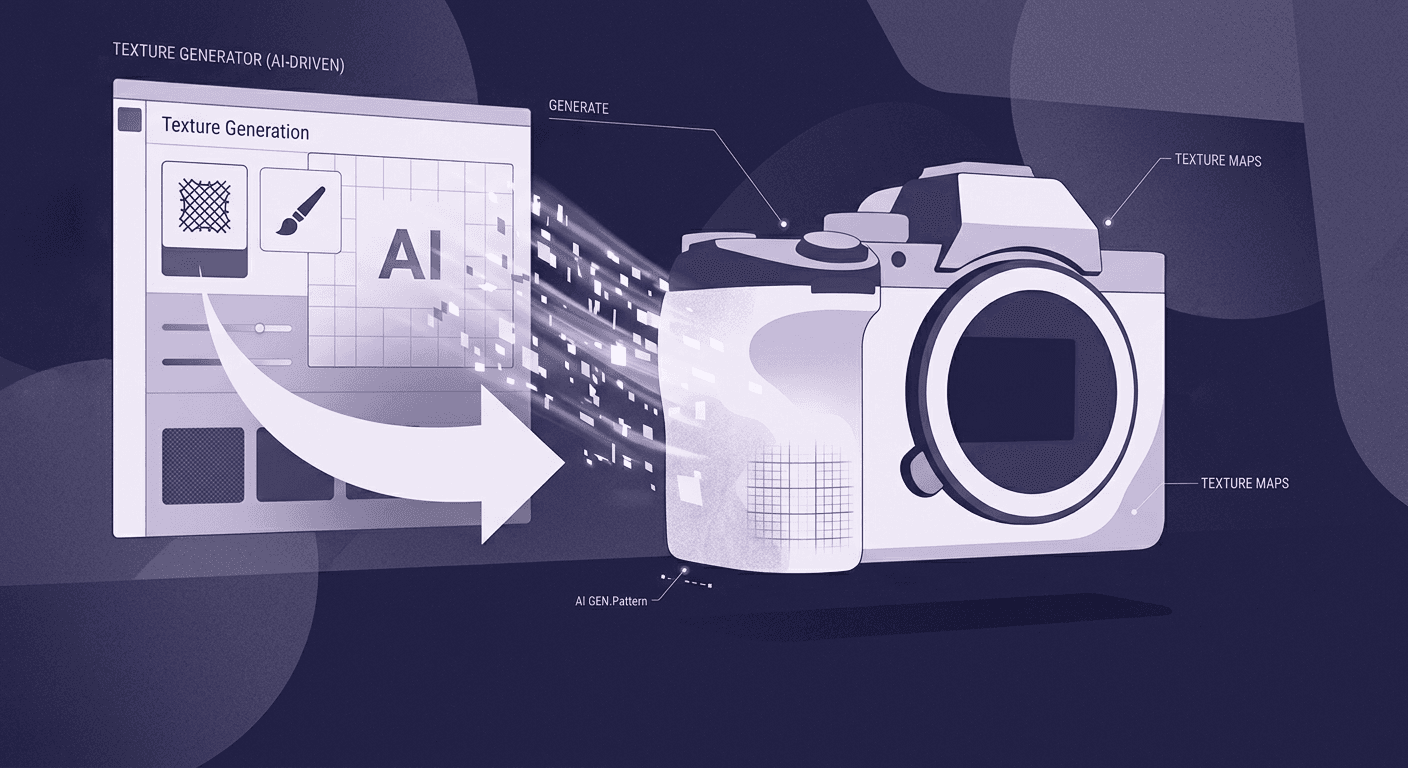
The latest advancement in this space is the integration of AI into texture workflows. AI-powered systems enable designers to generate textures from prompts or base images, significantly accelerating the ideation process.
Instead of manually creating each variation, teams can:
- Generate multiple texture options instantly
- Convert images into seamless, tileable patterns
- Automatically produce PBR maps aligned with the base texture
This reduces the technical overhead traditionally associated with texture creation and allows designers to focus on decision-making rather than execution.
Platforms like Texturly bring these capabilities into a unified workflow. By combining seamless texture generation, PBR map creation, and real-time adjustments (brightness, contrast, saturation, and sharpness), they enable teams to move from concept to production-ready material much faster.
For industrial design managers, this represents a shift from iteration-limited processes to scalable experimentation, where texture innovation is no longer constrained by time or cost.
Key methodologies for integrating texture into product design
Building a reusable texture library
One of the most effective ways to scale texture usage across teams is to develop a centralized texture library. Instead of creating textures from scratch for every project, leading design teams build curated collections of validated materials that can be reused across products.
These libraries typically include:
- Seamless base textures
- Associated PBR maps
- Defined parameters (scale, roughness, reflectivity)
- Usage guidelines
This approach not only accelerates the design process but also ensures consistency across product lines. It allows teams to work faster while maintaining a unified material language.
Standardizing texture parameters across teams
A common source of misalignment is the lack of standardized texture definitions. Designers may describe a surface as “slightly rough” or “semi-matte,” while engineers require precise specifications to implement it correctly.
To address this, teams establish quantifiable parameters for textures, such as:
- Roughness values
- Pattern density and scale
- Surface depth and variation
By translating subjective descriptions into measurable attributes, texture becomes easier to communicate, replicate, and validate. This creates a shared framework that aligns design intent with engineering execution.
Iterating textures without physical prototypes
Reducing dependency on physical prototypes is critical for improving efficiency. By leveraging digital tools, teams can iterate on textures in real time, testing variations, comparing options, and refining outcomes without producing physical samples.
This enables:
- Faster decision-making cycles
- Reduced material waste
- Greater flexibility in exploring alternatives
Only the most viable texture options are moved forward into physical prototyping, significantly lowering overall development costs.
Testing texture behavior across lighting and materials
Texture performance is highly context-dependent. A surface that looks refined under one lighting condition may appear overly reflective or flat under another. Similarly, the same texture applied to different materials can produce varying results.
To ensure reliability, leading teams test textures across:
- Multiple lighting environments (studio, natural, low-light)
- Different material bases (plastic, metal, fabric)
- Various product geometries
This validation process helps identify potential issues early, ensuring that textures perform consistently in real-world scenarios.
By implementing these methodologies, texture transitions from an isolated design decision to a structured, repeatable process. For industrial design managers, this creates a more predictable workflow, reducing errors, improving collaboration, and enabling scalable innovation across teams.
Solving real-world challenges: From miscommunication to material consistency
Bridging the gap between design and engineering
One of the most persistent challenges in product development is the disconnect between design intent and engineering execution. Texture is particularly vulnerable to this gap because it is often communicated visually but implemented technically.
Designers may define a surface through renders or references, while engineers interpret it through manufacturing constraints and material behavior. Without a shared system, this translation introduces variability, resulting in finishes that deviate from the original vision.
To address this, leading teams treat texture as a specifiable asset, not a subjective layer. By defining textures through measurable parameters and standardized maps (such as roughness and normal), both design and engineering teams can work from the same source of truth. This reduces interpretation errors and ensures that what is designed is what gets produced.
Reducing costly prototype cycles
Prototype iteration is one of the most resource-intensive aspects of product design, and texture decisions often amplify this cost. Small changes in surface finish can require entirely new samples, especially when tooling or material processes are involved.
By shifting texture validation into digital environments, teams can eliminate a large portion of these iterations. Designers can test multiple variations, refine details, and validate performance before committing to physical production.
This approach leads to:
- Fewer prototype cycles
- Lower material and manufacturing costs
- Shorter development timelines
Instead of using prototypes to explore possibilities, they are used to confirm decisions, making the process far more efficient.
Ensuring consistency across product lines
Consistency is critical for both brand identity and user experience. However, when textures are developed in isolation for each product, variations inevitably occur. Differences in scale, finish, or pattern application can create a fragmented visual language across a product portfolio.
A structured texture workflow solves this by enabling repeatable application of materials. With centralized libraries and standardized parameters, textures can be reused and adapted without losing consistency.
This is particularly important for large product ecosystems, where multiple teams work on different components or product lines. A unified texture system ensures that all outputs align with the brand’s material identity, regardless of who is executing the design.
Future outlook: Texture-driven product innovation
Smart and adaptive materials
The next wave of product innovation will move beyond static textures toward responsive and adaptive surfaces. Advances in material science are enabling textures that can change properties based on interaction, adjusting grip, temperature response, or visual appearance in real time.
For industrial design teams, this introduces a new layer of complexity. Texture will no longer be a fixed specification but a dynamic behavior that must be designed, simulated, and validated across multiple conditions. This shift will require tighter integration between design, engineering, and material science disciplines.
AI-assisted design systems
AI will play a central role in how textures are created and managed. Instead of manually designing each variation, teams will increasingly rely on AI systems to generate, optimize, and adapt textures based on defined constraints.
This enables:
- Rapid exploration of multiple design directions
- Automated optimization for manufacturability
- Consistent application of texture across product families
More importantly, AI will help bridge the gap between intent and execution, translating high-level design goals into technically viable material definitions.
Fully digital product development pipelines
As digital tools mature, product development is moving toward fully virtual pipelines, where decisions are validated before any physical prototype is created. In this environment, textures become critical assets that must perform accurately across simulations, renderings, and engineering validations.
Seamless textures and PBR materials will form the foundation of these pipelines, ensuring that what is seen in digital environments closely matches real-world outcomes. This reduces risk, shortens development cycles, and enables more confident decision-making.
Convergence of design, engineering, and material systems
Perhaps the most significant shift is the convergence of traditionally separate domains. Texture sits at the intersection of design aesthetics, engineering constraints, and material behavior. As workflows become more integrated, these domains will operate within shared systems rather than isolated processes.
For design leaders, this means rethinking how teams collaborate and how tools are structured. Texture will act as a unifying layer, connecting visual intent with technical execution and material performance.
Texture as a system, not a surface
Texture is no longer a finishing detail applied at the end of the design process; it is a system that influences how products are conceived, developed, and experienced. From improving usability and perception to reducing prototype cycles and aligning teams, its impact extends across the entire product lifecycle.
The shift toward digital workflows, AI-driven tools, and scalable material systems is redefining how textures are created and applied. For industrial design managers, the opportunity lies in integrating these capabilities into a cohesive process, one that enables faster iteration, clearer communication, and consistent execution.
Tools like Texturly support this transition by streamlining texture generation, enabling seamless tiling, and automating PBR map creation within a single workflow. Rather than treating texture as an isolated task, they position it as part of a broader design infrastructure.
Ultimately, the teams that treat texture as a strategic system, not just a surface, will be better equipped to innovate, scale, and deliver products that meet both functional and experiential expectations.

Mira Kapoor
Mira leads marketing at Texturly, combining creative intuition with data-savvy strategy. With a background in design and a decade of experience shaping stories for creative tech brands, Mira brings the perfect blend of strategy and soul to every campaign. She believes great marketing isn’t about selling—it’s about sparking curiosity and building community.
Latest Blogs
The Indie Dev Guide to CC0 PBR Textures: Stop Searching, Start Cr...
PBR textures
AI in 3D design

Mira Kapoor
Jul 10, 2026
Sourcing Free Game Textures: Navigating PBR Pipelines and Stylize...
PBR textures
Game textures
Mira Kapoor
Jul 6, 2026
Sculpting with Sunlight: The Architectural Physics of Facade Text...
Texture creation
AI in 3D design

Max Calder
Jul 1, 2026

Accelerate you workflow
with automated PBR texture generation
Enjoy creative freedom with AI powered texture creation
 Texturly
Copyright © 2026 Texturly, Asha Technology Labs Pvt. Ltd. All rights reserved