Sculpting with Sunlight: The Architectural Physics of Facade Textures
By Max Calder | 1 July 2026 | 8 mins read
Table of contents
Table of Contents
What if you could build a structure that completely alters its visual personality throughout the day, shifting from a soft, warm monolith at dawn to a dramatic, hyper-contrasted sculpture by midday, without a single moving part or electronic component? Masters of architecture do this seamlessly, and their secret lies in the texture of the building's facade.
The exterior skin of a building is rarely just a barrier against the elements. It functions as a dynamic canvas where natural sunlight is captured, broken apart, absorbed, or reflected. For modern architects, sustainable engineers, and digital world-builders alike, manipulating this interplay of light and shadow is a powerful dual-purpose toolkit. It doesn't just dictate how a building feels to the human eye; it directly alters the building's thermal performance, energy footprint, and relationship with its environment.
In this deep dive, we’re pulling back the curtain on the art and science of facade textures. We will explore how physical surfaces manipulate light, examine where these principles are applied across scales, and break down how digital innovators are using cutting-edge AI tools to replicate these complex real-world physics instantly in virtual environments.
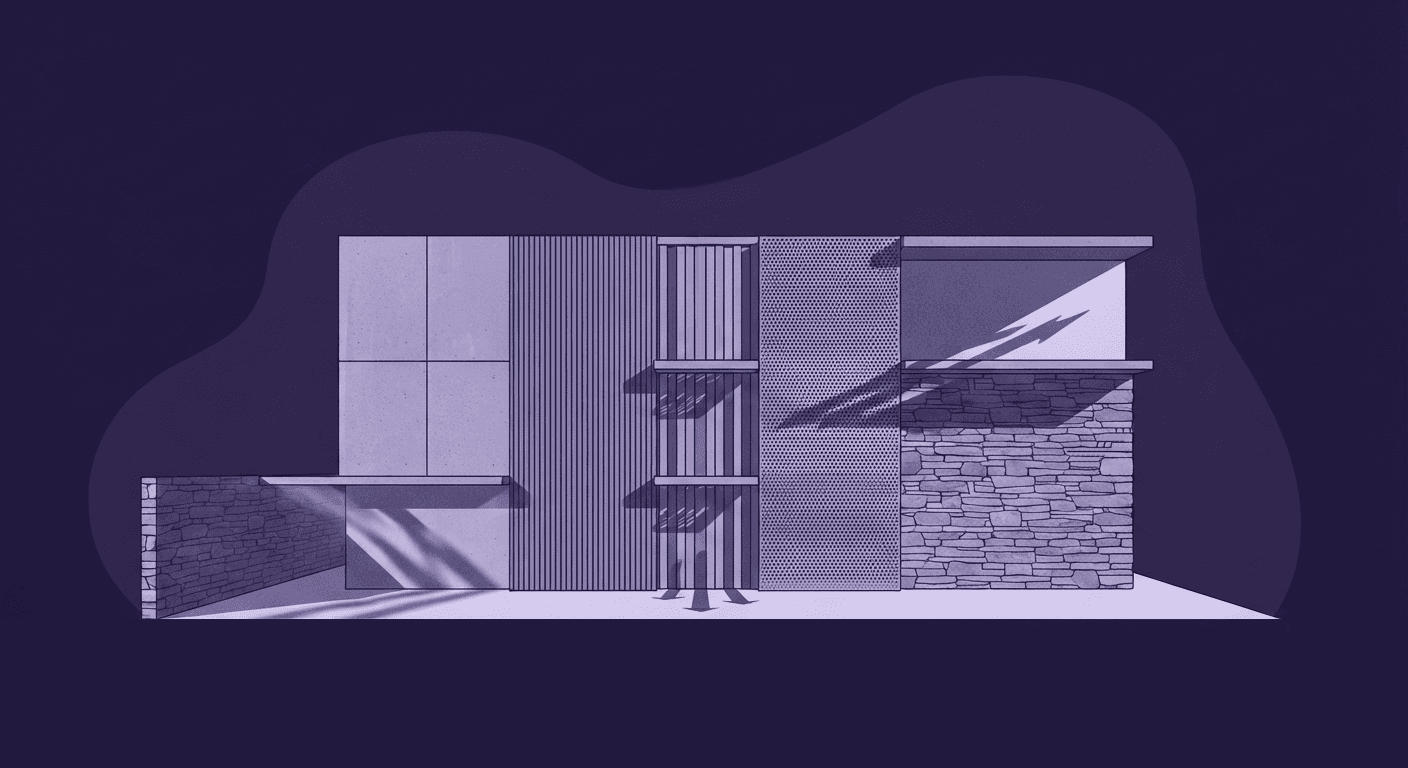
Sculpting mood, presence, and thermal comfort with light
Before examining specific materials, it is essential to understand why light and shadow matter so much on an architectural scale. Light is entirely invisible until it strikes a surface. Therefore, the texture of a facade is what actually gives light a visual form.
The psychology of architectural skin
Imagine a perfectly flat, monolithic glass-and-steel skyscraper. On an overcast day, it can appear cold, flat, and completely detached from its surroundings. Now, picture an ancient stone cathedral or a modern textured-concrete museum. Even under grey skies, the micro-crevices, pits, and ridges catch ambient light, casting millions of microscopic shadows that communicate a sense of weight, history, and physical permanence.
Shadows are the primary tool human eyes use to perceive depth and scale. By strategically introducing tactile roughness to a building's envelope, designers create visual tension and relief. A highly textured facade engages the passerby, drawing the eye across changing patterns of shade that tell a silent story about the time of day and the changing seasons.
The thermal realities of material depth
However, this isn't purely a game of aesthetics. Every time light hits a facade, it brings radiant heat. A completely flat facade absorbs this energy uniformly across its surface area. By introducing texture, architects create an elegant system of micro-shading. The protrusions of a texture cast shadows over adjacent recessions, effectively shielding parts of the building from direct solar exposure.
Understanding this dynamic allows designers to use texture as a passive heating and cooling mechanism, bridging the gap between artistic expression and environmental engineering.
Three fronts of tactile architecture
To master the language of light and shadow, designers look at textures through three distinct scales of application. Each scale targets a different behavior of light and serves a unique functional purpose.
1. Micro-textures (the material level)
Micro-textures exist at the millimetric scale of the material itself. This includes the subtle grain of raw timber, the pitting of travertine stone, the fine aggregate of acid-washed concrete, or the grain of bead-blasted aluminum.
These finishes dictate whether light undergoes specular reflection (mirror-like bounce) or diffuse scattering (soft, uniform spreading). For instance, a brushed titanium facade will scatter harsh midday sun into a soft, ethereal glow, preventing dangerous glare from blinding pedestrians at street level while giving the building a sleek, metallic presence.
2. Macro-textures (The structural level)
Macro-textures step back to look at the geometry of the building components themselves. Think of deep-set brick courses, protruding stone rustication, corbeled masonry, or structural brise-soleil (sun-shading) louvers.
At this scale, shadows become bold architectural statements. Deep recessions create crisp, dark voids that contrast sharply with illuminated surfaces. During high noon, when the sun is at its most punishing angle, macro-textured brickwork or deeply inset windows cast pronounced shadows downward, naturally keeping the building envelope cooler and reducing the strain on internal air conditioning systems.
3. Parametric and kinetic facades (the dynamic level)
With the rise of computational design, architects can now create macro-textures that adapt dynamically. Parametric facades utilize complex, algorithmic patterns, such as perforated metal screens or angled origami panels, specifically calibrated to the solar path of the building's exact geographic coordinates.
These facades act as an engineered skin. In the morning, the angles of the texture let in soft, indirect light to illuminate interior workspaces. As the sun climbs and becomes harsher, the geometry of the panels effectively blocks the direct burning rays, casting a complex matrix of defensive shadows across the building's surface to maintain a stable interior climate.
The physics of surface interaction and energy optimization
Achieving predictability with facade lighting requires a foundational understanding of material physics. It comes down to how a surface processes photons and how those interactions translate into BTUs of heat energy.
Roughness vs. Specular dynamics
Every material possesses a specific property that determines how light bounces off its surface.
- Low-roughness surfaces (polished/glossy): These materials focus light. A polished glass or smooth metal facade preserves the angle of incoming light, bouncing it directly onto neighboring buildings or the street. This can create hazardous urban heat islands and blinding glare.
- High-roughness surfaces (matte/textured): These surfaces break up light waves. When photons hit a rough, textured stucco or split-face block, they bounce off in thousands of random directions. This scatters both the visual glare and the thermal energy, allowing the building to ease gently into its landscape.
The science of self-shading performance
The ultimate goal of leveraging macro-textures for sustainability is optimizing the solar heat gain. By utilizing deeply articulated textures, a building can become self-shading.
During the summer months, when the sun rides high in the sky, a deeply textured facade blocks a massive percentage of direct radiation, absorbing it only on the tips of protruding elements while keeping the vast majority of the wall surface in cool shade. Conversely, during the winter, when the sun sits low on the horizon, the light slides underneath the horizontal protrusions, striking the facade fully to naturally warm the building's thermal mass.
From physical envelopes to digital archViz and game environments
The sophisticated logic that architects use to sculpt physical brick, metal, and concrete has become highly valuable for a completely different industry: digital world-building, Architectural Visualization (ArchViz), and video game development.
Translating real-world physics to virtual optimization
In the virtual space, game artists and ArchViz specialists face an inverse challenge. They need to make digital buildings look incredibly realistic without melting the user’s graphics card or dropping the frame rate. How do they achieve this? By studying real-world facade physics.
Digital artists use layered textures inside real-time rendering engines like Unreal Engine or Unity to simulate the exact macro and micro-textures of a building facade. Instead of modeling every single protruding brick or pitted concrete pocket with millions of memory-heavy polygons, they use specialized image maps to trick incoming digital light into scattering and casting shadows exactly like real-world materials do.
When an environment artist understands that an acid-washed concrete wall requires a specific roughness setting and an intricate normal map to scatter light diffusely, they can build virtual cityscapes that feel grounded, heavy, and authentic.
Generating architectural realism on demand
Historically, translating these precise real-world facade physics into digital assets was a grueling manual process. An artist would have to spend hours hunting down high-resolution imagery, manually stamping out seams to make the texture tile cleanly across a 50-story virtual skyscraper, and painstakingly extracting map layers.
This is exactly where Texturly completely redefines the production pipeline.
From text prompt to photorealistic PBR material
Texturly allows architects, industrial designers, and environment artists to generate hyper-realistic, complex architectural surfaces instantly from simple text prompts. Need a highly specific facade material to test light scattering? Simply input:
"Industrial acid-washed concrete panels with deep pitting and subtle rain streaks"
The AI engine instantly generates a high-fidelity visual asset tailored to your exact prompt. It completely bypasses the need for costly stock texture subscriptions or manual photography.
Automated PBR map extraction for true light behavior
As we explored in the physics section, light cannot be reliably reflected without surface data. Texturly doesn’t just generate flat 2D images; it automatically constructs a complete, production-ready Physically Based Rendering (PBR) map set.
When you generate a facade texture, Texturly delivers the corresponding Normal Maps (which calculate micro-shadow depth for protruding brick or pitted concrete) and Roughness Maps (which dictate whether an alloy scatters light diffusely or concentrates it into a specular glint). Drop these Texturly-generated maps directly into your render engine, and the digital sunlight will slide, catch, and pool across the surface exactly like its real-world counterpart.
Eliminating the grid: Flawless, seamless tiling
One of the biggest hurdles in architectural visualization is texturing massive vertical surfaces. If a texture isn't perfectly tileable, wrapping it across a massive skyscraper design creates a glaring, artificial "grid monster" effect where the edges of the image repeat visibly.
Texturly solves this bottleneck with an intelligent, built-in algorithmic system that makes any generated texture 100% seamless. The borders are blended analytically, preserving the natural variance in timber grain, concrete imperfections, and masonry joints. This allows designers to tile a single material infinitely across an entire urban district, maintaining sharp resolution and flawless visual continuity without a single broken seam.
Sealing the spatial seam: The future of dynamic AR surfaces
At the end of the day, texture is far more than a decorative addition to a building. It is a highly functional system that regulates how a structure communicates visually with the human mind, thermodynamically with the planet, and computationally inside our digital rendering pipelines.
As we move deeper into an era that demands sustainable, energy-conscious building solutions in the physical world and immersive, high-performance optimization in the virtual one, relying on unoptimized, flat designs is no longer viable. Designers must embrace the power of material depth, using micro-textures to tame blinding glare and macro-textures to introduce passive, self-shading systems.
By shifting away from slow, legacy manual asset hunting and leveraging advanced AI engines like Texturly, creators can bridge the gap between imagination and execution. You can now generate, tile, and implement complex architectural physics in seconds. The sun will continue to chart its course across the sky every single day, and with the right tools in your pipeline, you can control exactly how your world steps into the light.

Max Calder
Max Calder is a creative technologist at Texturly. He specializes in material workflows, lighting, and rendering, but what drives him is enhancing creative workflows using technology. Whether he's writing about shader logic or exploring the art behind great textures, Max brings a thoughtful, hands-on perspective shaped by years in the industry. His favorite kind of learning? Collaborative, curious, and always rooted in real-world projects.
Latest Blogs

The Indie Dev Guide to CC0 PBR Textures: Stop Searching, Start Cr...
PBR textures
AI in 3D design

Mira Kapoor
Jul 10, 2026
Sourcing Free Game Textures: Navigating PBR Pipelines and Stylize...
PBR textures
Game textures
Mira Kapoor
Jul 6, 2026

Why Your ARKit Textures Warp, Drift, and Lag And How to Fix It
Product rendering
3D textures

Max Calder
Jun 26, 2026

Accelerate you workflow
with automated PBR texture generation
Enjoy creative freedom with AI powered texture creation
 Texturly
Copyright © 2026 Texturly, Asha Technology Labs Pvt. Ltd. All rights reserved