Think Like a Textile Engineer: Build Fabric Textures That Actually Behave
By Mira Kapoor | 11 March 2026 | 18 mins read
Table of contents
Table of Contents
Staring at a 3D render where the fabric just feels wrong. You’ve got high-res maps, and the lighting is perfect, but the silk drapes like cardboard, and the cotton has a weird, plastic sheen. This guide fixes that by going deeper than the texture map. We’re going to unpack the fundamental science of cloth, from fiber and weave to the final manufacturing finish, and show you how to translate that knowledge into digital materials that are truly convincing. It’s about learning to think less like a texture artist and more like a textile engineer. Understanding the why behind a fabric's structure is the key to creating assets that don’t just look right, but behave right, streamlining your workflow from physical swatch to final render.
What really defines cloth material textures?
Most digital artists think about texture as a set of maps, albedo, normal, and roughness. They’re right, but that’s the last step in a long story. A fabric’s texture isn't just a surface detail; it’s the physical result of decisions made at every stage of its creation, from the choice of fiber to the final chemical wash. Understanding this story is the difference between a digital render that looks like cotton and one that behaves like it.
Let’s unpack the fundamentals. To create truly accurate digital assets, you need to think less like a painter and more like a textile engineer.
Beyond the surface: Breaking down textile surface characteristics
First, we need to separate two concepts that often get bundled together: tactile texture and visual texture.
- Tactile texture is what you feel. It’s the physical sensation of running your hand over a fabric. Is it fuzzy like flannel, bumpy like boucle, or slick like satin? This is governed by the physical structure of the yarns and the way they’re assembled.
- Visual texture is what you see. It’s the pattern of light and shadow created by the fabric's surface. A high-resolution photo can capture visual texture, but it can’t tell you if the fabric is stiff or soft, heavy or light.
In digital workflows, we often obsess over the visual and forget the tactile. But the tactile informs the visual, and more importantly, it dictates the physics. The reason a fabric feels a certain way is down to three core scientific properties:
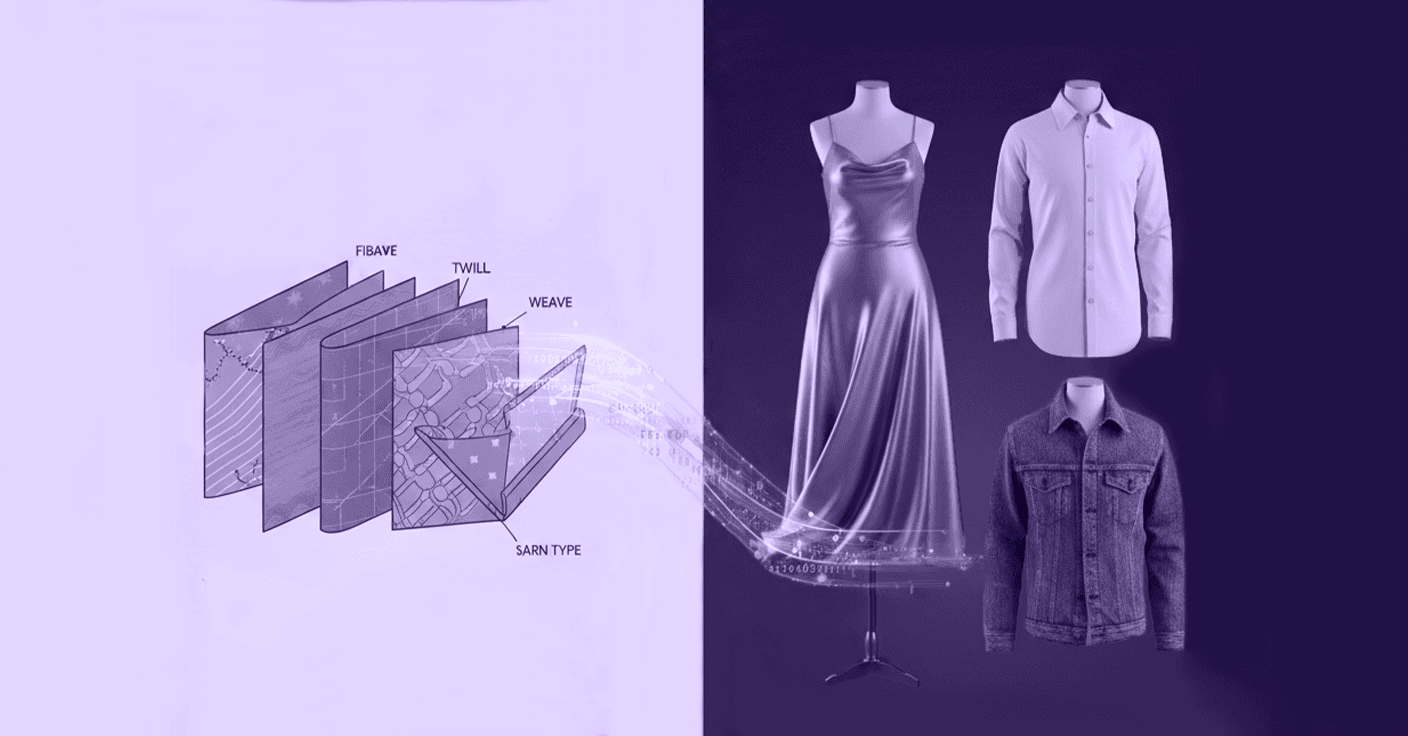
- Weave (or knit): This is the architectural blueprint. It’s the pattern in which yarns are interlaced. A tight, simple plain weave creates a crisp, stable surface like poplin. A satin weave, with its long, floating yarns, produces a smooth, light-reflecting surface.
- Yarn type: Are the yarns thick or thin? Are they fuzzy with loose fibers (woolen-spun) or smooth and tight (worsted-spun)? A thick, loosely spun yarn will create a soft, insulating fabric like fleece, while a fine, tightly twisted yarn results in a smooth, strong fabric like percale.
- Finish: This is the post-production process where a raw fabric, known as greige goods, is transformed. It can be brushed to raise a fuzzy nap (flannel), treated with chemicals to add sheen (mercerization), or calendared (pressed between hot rollers) to create a slick, non-porous surface like chintz.
Why does this foundation matter for digital accuracy? Because if you only copy what you see, you miss the “why.” You’ll get the look right, but the drape, the weight, and the way the fabric reacts to light will feel off. Building from this foundation ensures your digital materials are grounded in reality.
How texture and material interact to define a fabric
The structure is only half the equation. The other half is the raw material itself. The choice of fiber is the single most important factor influencing a fabric's final character. Let’s explore how.
The role of fiber source: Natural vs. Synthetic fibers
Fibers are broadly split into two camps: natural (from plants or animals) and synthetic (man-made polymers). Each brings its own inherent properties to the table.
- Natural fibers like cotton, linen, wool, and silk have unique microscopic structures. Cotton fibers are flat, twisted ribbons that are highly absorbent and soft. Wool has a natural crimp and scales, making it an excellent insulator that feels springy. Linen fibers are long and smooth but stiff, leading to a crisp feel and characteristic wrinkling.
- Synthetic fibers like polyester, nylon, and acrylic are engineered for performance. They are extruded as long, smooth filaments. This gives them strength, durability, and moisture-wicking properties, but they often lack the subtle surface variations and breathability of natural fibers.
How does the same weave feel different in cotton vs. polyester
This is where it all comes together. Take a twill weave, the diagonal pattern famous for denim. Now, let’s see what happens when we use different fibers:
- Cotton twill: Think of classic denim or chinos. The cotton fibers are relatively soft and absorbent. The fabric will have a soft hand-feel, it will breathe well, and it will develop subtle fades and wrinkles over time. Its visual texture is matte, absorbing more light than it reflects.
- Polyester twill: Now, imagine a fabric for work uniforms or durable upholstery. The polyester fibers are smooth, strong, and non-absorbent. The resulting twill will be crisp, highly resistant to wrinkles and abrasion, and will likely have a slight sheen. It won’t feel as soft or breathable against the skin.
The weave is identical, but the fiber choice completely changes the fabric's performance, feel, and visual properties. One is perfect for a comfortable pair of jeans; the other is built for a rugged backpack.
Answering the question, what defines a fabric's texture at a molecular level? It's the interplay between the polymer chains of a synthetic fiber or the cellular structure of a natural fiber and the geometric arrangement (the weave or knit) they are forced into. This combination dictates everything from stiffness and moisture management to how light bounces off the surface.
Understanding this interaction is the key to moving beyond generic material presets and creating digital fabrics with true-to-life specificity. Next, let’s look at the machinery and processes that bring these textures to life.
The creation process: A look at textile manufacturing techniques
Now that we've covered the ingredients, fiber, and structure, let's move into the kitchen. Textile manufacturing is where these raw components are transformed into the cloth material textures we interact with daily. This isn't just trivia for a factory tour, understanding how a fabric is made is critical to deconstructing it for digital recreation.
Weaving and knitting: The structural core of texture
At the heart of nearly every fabric is one of two processes: weaving or knitting. They are fundamentally different methods of interlocking yarn, and that difference is the primary dictator of a fabric’s mechanical properties, like stretch, drape, and stability.
Exploring fundamental fabric weaving processes
Weaving interlaces two sets of yarns at right angles: the lengthwise warp and the crosswise weft. The pattern of this interlacing defines the weave and its resulting texture.
- Plain weave: The simplest structure. Each weft yarn goes over one warp yarn and under the next. This creates a stable, durable, and balanced grid-like surface. Think of cotton poplin, chiffon, or linen. The texture is often crisp, and the surface is flat and matte.
- Twill weave: The weft yarn floats over two or more warp yarns before going under one, with the pattern offset on each row. This creates a distinct diagonal rib on the surface. Twill weaves are more pliable, drape better than plain weaves, and are more durable. Denim, gabardine, and herringbone are all twills.
- Satin weave: Here, the weft yarn floats over four or more warp yarns. This minimizes interlacing points, creating an exceptionally smooth, lustrous surface because light reflects uniformly off the long floats. Satin, sateen, and charmeuse are prime examples. The trade-off? It’s less durable and prone to snagging.
How knitting patterns create inherent texture and stretch
Knitting, unlike weaving, uses a single continuous yarn (or set of yarns) to form interlocking loops. This looping structure is what gives knitted fabrics their signature stretch and comfort.
- Jersey knit: This is the structure of your basic t-shirt. It has fine vertical ribs on the front (the knit side) and horizontal loops on the back (the purl side). It’s lightweight, drapes well, and stretches along its width.
- Rib knit: This knit alternates vertical columns of knit and purl stitches, creating prominent vertical ribs on both sides of the fabric. This structure has significant crosswise stretch and recovery, making it ideal for cuffs, collars, and form-fitting sweaters.
- Interlock knit: Think of this as two layers of jersey knit locked together. It’s thicker, heavier, and more stable than a single jersey, with a smooth surface on both sides. It has less stretch but offers a more substantial feel.
Understanding this structural core is essential for digital physics. A woven fabric will have limited stretch, primarily on the bias (diagonally), while a knit is designed to stretch. Setting these properties correctly in a simulation engine is the first step to realism.
Finishing and treatment: How post-production creates unique surfaces
Raw woven or knitted fabric is rarely the final product. It’s the finishing processes that fine-tune a fabric’s hand-feel, appearance, and performance. This is where a generic textile becomes a highly specific cloth material texture.
Mechanical finishes: Altering the surface by force
These processes use physical force, heat, pressure, and abrasion to change the fabric's texture.
- Brushing: The fabric is passed over abrasive, wire-covered rollers. This pulls up fiber ends from the yarn, creating a soft, fuzzy surface known as a nap. This is how you get flannel and fleece.
- Calendering: The fabric is passed through heated, high-pressure rollers. This flattens the yarns and the entire surface, increasing luster, smoothness, and density. It’s the secret behind the high sheen of chintz.
- Embossing: A heated roller with an engraved pattern presses into the fabric, creating a permanent, three-dimensional design. This is common in upholstery and decorative textiles.
Chemical finishes: Changing properties at a molecular level
These treatments use chemicals to impart specific qualities to the fabric that weren’t there originally.
- Mercerization: A treatment for cotton that uses a caustic soda solution. It causes the cotton fibers to swell, changing their cross-section from a flat ribbon to a round shape. This dramatically increases luster, strength, and dye affinity. It’s why high-quality cotton shirts have a subtle sheen.
- Flame retardants: Chemicals are applied to reduce a fabric's flammability, a critical finish for performance wear, children’s clothing, and public interiors.
- Softening agents: These are essentially fabric softeners applied at an industrial scale, used to improve the hand-feel of fabrics that might otherwise feel stiff or harsh after dyeing.
These finishing steps are what add the final layer of complexity and nuance. When you’re trying to replicate a specific fabric, asking “what was done to this after it was woven?” can unlock the secret to its unique texture. Now, let’s organize these possibilities into a practical framework.
A practical guide to fabric texture types
We’ve explored the theory, the fibers, the structures, and the finishes. Now it's time to build a mental library. Classifying fabric texture types isn't just an academic exercise; it's a practical tool for sourcing reference, building digital materials, and communicating with your team. This is about translating that technical knowledge into a repeatable workflow.
Classifying textures by their physical feel
Let's group common fabrics by their dominant tactile characteristic. When you're building a material, start by asking which of these buckets it falls into. This gives you an immediate baseline for its physical and visual properties.
- Smooth and crisp: These fabrics have a tight weave and are often made from fine, strong yarns. They hold their shape well and have a clean surface. Think of the sharp folds in a new dress shirt.
- Examples: Poplin (a tight plain weave), Taffeta (a crisp, calendared plain weave with a signature rustle), Organza (a stiff, sheer plain weave made from tightly twisted filaments).
- Examples: Poplin (a tight plain weave), Taffeta (a crisp, calendared plain weave with a signature rustle), Organza (a stiff, sheer plain weave made from tightly twisted filaments).
- Soft and fuzzy: These fabrics are designed for comfort and insulation. Their texture comes from raised fibers (a nap) that trap air and feel soft against the skin.
- Examples: Flannel (a brushed cotton), Fleece (a brushed synthetic knit), Velvet (a pile weave where extra yarns are cut to create a dense, standing nap).
- Examples: Flannel (a brushed cotton), Fleece (a brushed synthetic knit), Velvet (a pile weave where extra yarns are cut to create a dense, standing nap).
- Textured and coarse: These fabrics have a noticeable, often irregular surface created by thick, novelty, or slub yarns. They have a rustic, organic feel.
- Examples: Tweed (a rough, woolen twill, often with flecks of color), Boucle (made with looped or curled yarns, creating a bumpy surface), Linen (known for its natural slubs, or thick spots in the yarn).
- Examples: Tweed (a rough, woolen twill, often with flecks of color), Boucle (made with looped or curled yarns, creating a bumpy surface), Linen (known for its natural slubs, or thick spots in the yarn).
- Sheer and delicate: Defined by their transparency, these fabrics are made from extremely fine yarns in an open weave or knit. Their texture is more about lightness and airiness than a distinct surface feel.
- Examples: Chiffon (a lightweight, sheer plain weave with a slightly rough feel from twisted yarns), Georgette (similar to chiffon but denser and more crinkled), Tulle (a fine, hexagonal netting).
This classification system gives you a shared language. Instead of saying “a rough jacket fabric,” you can say “something like a tweed or boucle,” which immediately provides a much clearer technical starting point.
Understanding textile surface properties for digital applications
Now, let's connect these physical categories to the digital world. The goal is to translate the feel and behavior of a real-world fabric into the parameters of a PBR material and a physics simulation. This is where your deep understanding pays off.
How different fabric textures reflect light (specularity and roughness)
The interaction of light with a fabric's surface is one of the most important aspects of realism. It’s defined primarily by the microscopic smoothness of the fibers and the macroscopic structure of the weave.
- Smooth/Satin: Fabrics like satin or mercerized cotton have long, flat yarn floats and smooth fibers. This creates a surface with low roughness and higher specularity. Light reflects directionally, creating sharp, defined highlights.
- Soft/Fuzzy: Fabrics like fleece or velvet have a surface covered in upright fibers (the pile). These fibers trap and scatter light, resulting in a material with very high roughness and almost no specularity. The appearance is matte and diffuse, with a characteristic soft falloff or sheen that changes with viewing angle.
- Coarse/Linen: These textures have an uneven surface due to thick yarns and a prominent weave. Light scatters diffusely, so roughness is high. However, you might see tiny glints of specularity from individual fibers, which can be replicated with a detailed normal or roughness map.
Translating physical drape and weight into digital physics
How a fabric hangs and moves is just as important as how it looks. You can use your knowledge of its construction to set physics properties more intelligently.
- Weight/Mass: A heavy tweed will have a high mass value in a cloth simulation, making it hang heavily. A sheer chiffon will have a very low mass, allowing it to float.
- Stiffness/Bend resistance: The structure is key here. A tightly woven poplin is crisp and will resist bending, requiring a higher stiffness value. A jersey knit, by contrast, is designed to be pliable and would have a very low bend resistance.
- Stretch: This is the most obvious one. Woven fabrics have almost no stretch (except on the bias). Knits have significant stretch. Adjusting the stretch and shear parameters in your simulation based on whether the fabric is a weave or a knit is a non-negotiable step.
By building your digital material library around these physical classifications, not just folders named red fabrics, you create a powerful, predictable system. You can quickly find a baseline material and know exactly which parameters to tweak to achieve a specific real-world textile.
Why a deep understanding of texture improves digital workflows
We’ve journeyed from the molecular structure of a fiber to the practical classification of fabrics. So what? The ultimate goal isn't to become a textile scientist; it's to build better, more realistic digital assets faster. A deep understanding of cloth material textures bridges the gap between the physical and digital, transforming your workflow from guesswork into a structured, efficient process.
The impact of texture on fabric performance in a digital context
In digital prototyping, product visualization, and animation, accuracy is everything. A client in the apparel industry needs to know how a virtual garment will hang, move, and react to light before a single yard of fabric is cut. This is where your foundational knowledge becomes a competitive advantage.
Ensuring material accuracy for realistic digital prototyping and renders
When a digital prototype fails, it’s often because the material properties are wrong. Imagine presenting a digital collection where a heavy wool coat moves with the lightness of silk, or a crisp poplin shirt collapses like soft jersey. It immediately shatters the illusion and undermines trust in the digital process.
- Simulating movement: Understanding that a satin weave is slick and has low friction helps you set simulation parameters that allow it to slide over itself realistically. Knowing that coarse linen has more friction helps you create more believable wrinkles and folds.
- Stress and durability: In a gaming or VFX context, knowing that a twill weave is strong and resists tearing along its diagonal lines can inform how you create damage effects. A delicate chiffon, on the other hand, should be programmed to tear or fray easily under stress.
By building your digital materials from the ground up, fiber, weave, and finish, you ensure they don't just look right, they act right. This moves you beyond surface-level aesthetics to true functional simulation.
Streamlining the material selection process with a technical foundation
Think about the typical feedback loop: an art director says a fabric "doesn't feel right." What does that mean? Is it too stiff? Too shiny? Not draping correctly? Without a shared technical vocabulary, you're stuck in a loop of subjective tweaks.
With a technical foundation, the conversation changes. You can diagnose the problem:
- The specularity is too high for a brushed cotton; let me increase the roughness map and kill the specular value.
- This is a plain weave, so the stretch parameters should be near zero. That's why it's behaving like a knit.
This precision drastically cuts down on revision cycles. It makes you a more effective problem-solver and a more valuable team member.
From physical swatch to realistic digital asset
The final payoff is in the pipeline itself. The process of translating a physical fabric swatch into a high-fidelity digital asset is notoriously difficult. A deep understanding of texture is the Rosetta Stone that makes that translation possible.
Techniques for capturing and recreating textile surfaces
Your knowledge informs your capture strategy. If you have a piece of velvet, you know its appearance is defined by its deep pile and how it traps light. A simple flat scan won't work. You’ll need a more advanced technique, like photogrammetry or polarized light scanning, to capture the subtle changes in sheen as the viewing angle shifts. For a simple cotton poplin, a high-resolution flatbed scan might be all you need to capture the fine weave for a tileable texture.
How does this knowledge improve communication between designers and 3D artists
This is perhaps the most significant workflow improvement. When a fashion designer can hand a swatch to a 3D artist and say, “This is a 6 oz. cotton twill with a brushed finish,” the artist has a wealth of information to start with:
- Cotton: Matte, soft, good wrinkle formation.
- 6 oz.: A specific weight to plug into the physics simulation.
- Twill: A diagonal pattern for the normal map, good drape.
- Brushed finish: High roughness, low specularity, soft appearance.
This is infinitely more useful than "a soft, blue pants fabric." It replaces ambiguity with data, allowing artists to work faster and with greater confidence.
By moving beyond aesthetics to create functionally accurate digital textiles, you’re not just making prettier pictures. You’re building a more robust, reliable, and efficient pipeline for digital creation. You’re future-proofing your skills and ensuring that, as digital fashion and product visualization become more sophisticated, your work will stand up to the closest scrutiny.
The blueprint, not just the picture
So, where does this leave you? You’ve journeyed from the microscopic twist of a cotton fiber to the high-pressure rollers of a finishing mill. The goal was never to turn you into a textile scientist, it was to give you the blueprint.
Before, you were likely capturing the picture of a fabric. Now, you understand the recipe. You know that a fabric’s sheen isn’t just a slider you tweak; it’s the result of long floats in a satin weave or a mercerization finish. You know its stiffness isn’t a random physics value; it’s dictated by a tight plain weave made from crisp linen fibers.
This is your new advantage. The next time a render feels off, you won’t be guessing. You’ll be diagnosing. You can look at a physical swatch, deconstruct it in your mind, fiber, weave, and finish, and translate it into a set of logical parameters. You can have a smarter conversation with a designer, turning subjective feedback into technical action.
Ultimately, this knowledge collapses the space between the physical and the digital. It turns a frustrating process of trial-and-error into a confident, repeatable workflow. You’ve got the foundation. Now, go build something real.

Mira Kapoor
Mira leads marketing at Texturly, combining creative intuition with data-savvy strategy. With a background in design and a decade of experience shaping stories for creative tech brands, Mira brings the perfect blend of strategy and soul to every campaign. She believes great marketing isn’t about selling—it’s about sparking curiosity and building community.
Latest Blogs
The Indie Dev Guide to CC0 PBR Textures: Stop Searching, Start Cr...
PBR textures
AI in 3D design

Mira Kapoor
Jul 10, 2026
Sourcing Free Game Textures: Navigating PBR Pipelines and Stylize...
PBR textures
Game textures
Mira Kapoor
Jul 6, 2026

Sculpting with Sunlight: The Architectural Physics of Facade Text...
Texture creation
AI in 3D design

Max Calder
Jul 1, 2026

Accelerate you workflow
with automated PBR texture generation
Enjoy creative freedom with AI powered texture creation
 Texturly
Copyright © 2026 Texturly, Asha Technology Labs Pvt. Ltd. All rights reserved